

What is the Labor Court Dubai and How Does it Function?
The Labor Court Dubai operates as a specialized judicial division within the Dubai Courts, specifically designed to adjudicate employment-related conflicts in the private sector. It’s the primary venue where legal theory meets practical resolution for both employers and employees. While many view litigation as a last resort, this court provides a structured, strategic environment to settle grievances that administrative mediation couldn’t resolve. It’s not just a courtroom; it’s a sophisticated mechanism that ensures the city’s economic landscape remains fair and predictable for international talent and local enterprises alike.
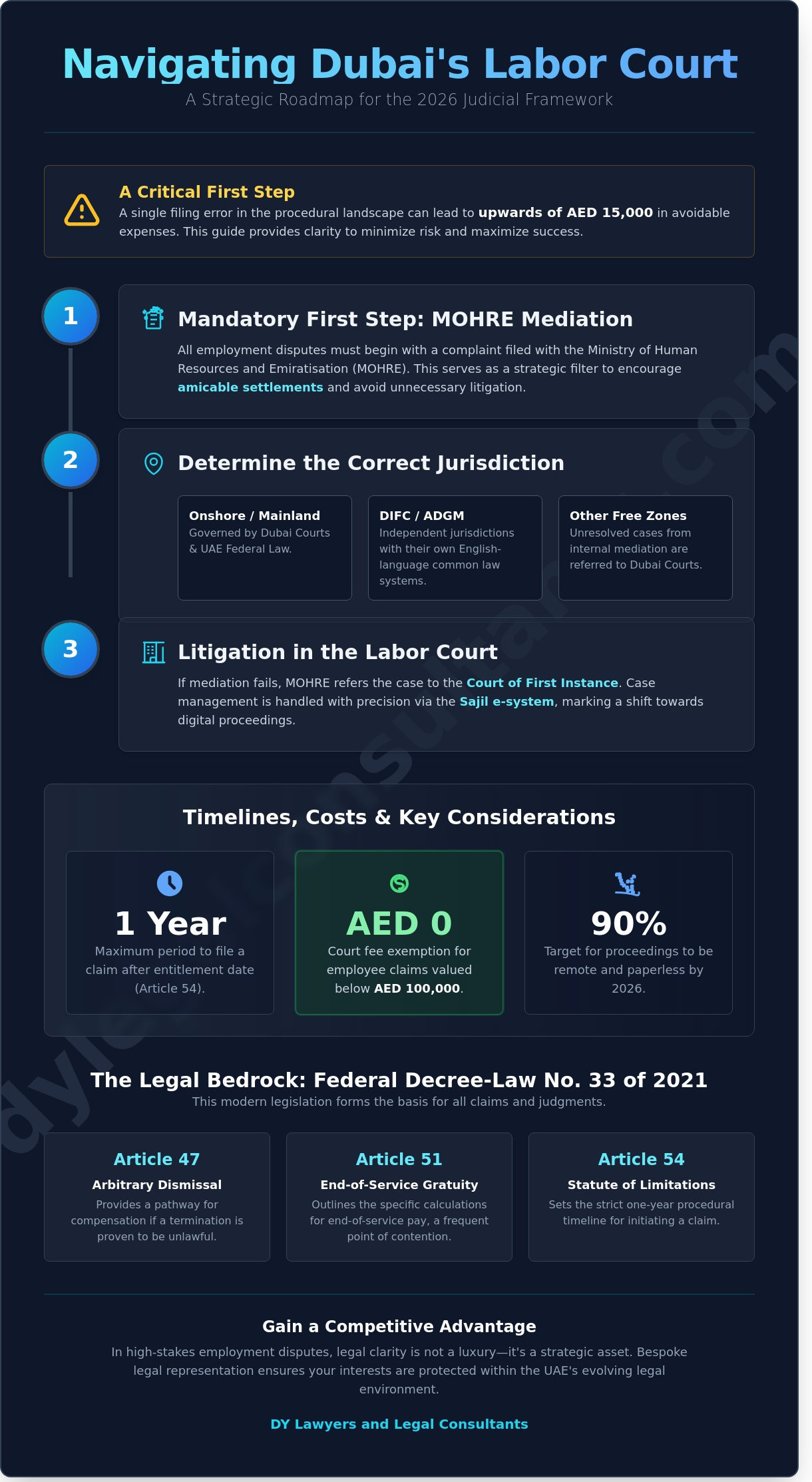
The Court of First Instance serves as the entry point for most litigation within this system. Here, a single judge or a panel of three judges reviews the evidence, hears arguments, and delivers a verdict based on the merits of the case. Since the implementation of new procedural rules on February 2, 2022, the court has prioritized digital transformation. By 2026, the goal is for 90% of these proceedings to occur through remote, paperless channels, significantly reducing the time it takes to reach a final judgment. This efficiency is a core component of the UAE’s commitment to providing a world-class legal framework.
Onshore vs. Free Zone Jurisdiction
Determining the correct forum is the first hurdle in any employment dispute. If your contract is registered with the Dubai Department of Economy and Tourism, the labor court dubai holds exclusive jurisdiction over your matter. However, the landscape shifts when dealing with specific financial hubs. The Dubai International Financial Centre (DIFC) and the Abu Dhabi Global Market (ADGM) operate under their own independent, English-language common law systems. They’ve their own courts and employment regulations that exist outside the standard Dubai Courts system.
- Mainland/Onshore: Governed by the Dubai Courts and UAE Federal Law.
- DIFC/ADGM: Independent jurisdictions with bespoke employment laws.
- Other Free Zones: Areas like DMCC or JAFZA initially use internal mediation, but unresolved cases typically move to the Dubai Courts.
The evolution of these judicial boundaries is closely linked to the history of UAE Migrant Worker Laws, which have continuously adapted to balance the needs of a diverse global workforce with the requirements of a rapidly expanding economy. We adopt a boutique approach to these jurisdictional challenges, ensuring that every case is filed in the correct venue to avoid costly procedural delays.
The Legal Framework: Federal Decree-Law No. 33
The bedrock of all proceedings within the labor court dubai is Federal Decree-Law No. 33 of 2021. This legislation, which became fully effective in early 2022, replaced the outdated 1980 framework to better reflect modern workplace dynamics. It introduced several critical changes that have streamlined litigation as we move toward 2026, including the mandatory transition to fixed-term contracts and clearer definitions for various work models like part-time and flexible work.
Key articles within this law provide the strategic basis for most claims:
- Article 47: Governs cases of arbitrary dismissal, providing a pathway for compensation if a termination is found to be unlawful.
- Article 51: Outlines the specific calculations for end-of-service gratuity, a frequent point of contention in the courtroom.
- Article 54: Sets the strict procedural timeline for filing a claim, which must be initiated within one year of the entitlement date.
The Labor Court Dubai acts as the final arbiter for all MOHRE-referred disputes, delivering binding judgments that uphold the integrity of the UAE’s contractual standards.
The Mandatory First Step: MOHRE Mediation and Referrals
The UAE legal framework requires every employment dispute to pass through a preliminary filter. You cannot approach the labor court dubai directly without first engaging with the Ministry of Human Resources and Emiratisation (MOHRE). This mandatory mediation phase serves as a strategic buffer. It’s designed to resolve conflicts through amicable settlements, saving both parties the time and expense of protracted litigation. Since the updated UAE Labor Law took effect on February 2, 2022, this process has become more streamlined and strictly timed. Understanding MOHRE’s Role in Labor Disputes is essential for any employer or employee seeking a swift resolution.
Filing the Initial MOHRE Complaint
To initiate the process, the claimant must register a formal dispute through the MOHRE smart app or official website. The system is highly digitized, requiring the input of specific details such as the labor contract number and the nature of the grievance. Once filed, a legal researcher from the Ministry contacts both parties to facilitate a discussion. This isn’t just a formality; it’s a genuine opportunity to settle. Success at this stage often hinges on the quality of your initial submission.
Documentation serves as the foundation of your future case. You should prepare your signed employment contract, recent bank statements showing salary transfers (or lack thereof), and any relevant correspondence like emails or WhatsApp messages. A common pitfall during mediation is making verbal concessions or signing settlement agreements without fully understanding the legal implications. These admissions can be used against you if the matter eventually reaches the labor court dubai. For those seeking a bespoke legal strategy, our team ensures every document aligns with judicial expectations from day one.
The Referral Letter and the 14-Day Rule
Efficiency defines the Ministry’s approach to dispute resolution. Under current regulations, MOHRE has a 14-day window to reach an amicable settlement between the parties. If the dispute remains unresolved after this period, or if the Ministry finds that a settlement is unlikely, the claimant can request a formal referral to the judicial system. This referral letter is your “ticket” to court. Without it, the judiciary lacks the jurisdiction to hear your case. It’s a vital document that summarizes the claims and the Ministry’s unsuccessful attempts at mediation.
Timing is everything once the referral is issued. The letter typically carries a strict validity period. If you fail to file your case within the timeframe specified in the referral, you may lose the right to pursue the claim in court. This requires a rapid transition from administrative mediation to formal litigation. At DY Legal Consultants, we manage this transition with precision. We ensure that the facts presented to MOHRE are perfectly consistent with the pleadings filed in court. This consistency protects your integrity as a claimant and prevents the opposition from finding procedural loopholes. Our boutique approach means we don’t just identify problems; we provide the strategic framework to move your case from a deadlocked mediation to a decisive court victory.
Navigating Labor Court Proceedings: A Step-by-Step Guide
Once the Ministry of Human Resources and Emiratisation (MOHRE) issues a transfer letter, the formal litigation phase begins. You must register your case through the Dubai Courts e-system, known as Sajil. This digital portal serves as the gateway to the labor court dubai, ensuring that all filings are tracked with absolute precision. Since the implementation of the remote litigation system in January 2022, the process has become significantly more streamlined. Most proceedings now occur in digital courtrooms, where judges review electronic files and conduct hearings via video conferencing. This shift requires a high degree of technical readiness and a clear understanding of virtual court etiquette.
The First Instance hearing is your primary opportunity to present the facts. Judges in the UAE legal system rely heavily on written submissions rather than lengthy oral arguments. We focus on drafting precise legal memorandums in Arabic, as this is the only language the court recognizes for official filings. A single mistranslated term or a vague legal reference can jeopardize a claim for thousands of dirhams. Our team treats these documents as strategic assets, ensuring every legal plea aligns with the latest UAE Labor Law updates. We don’t just file papers; we build a narrative that establishes your rights with clarity and authority.
Evidence and Documentation Strategy
Success in court depends on the strength of your documentation. We meticulously compile a dossier that includes Wage Protection System (WPS) records, bank statements, and internal company correspondence. Under UAE Federal Law No. 5 of 2017, digital evidence such as WhatsApp messages and emails is admissible and often carries significant weight in proving contractual breaches. Our boutique approach involves a bespoke analysis of your communications to highlight specific admissions of debt or changes in employment terms. All evidence not originally in Arabic must be legally translated by a licensed UAE translator to be accepted by the judge.
The Role of the Judicial Expert
In cases involving technical financial disputes or claims exceeding 50,000 AED, the judge often appoints a court-certified expert. This individual acts as a technical auditor, reviewing payroll records and end-of-service gratuity calculations. The expert’s report frequently forms the basis of the final judgment, making this stage critical. We provide proactive support during expert meetings, ensuring your financial data is presented accurately and any discrepancies in the opposing party’s records are highlighted. If an expert report is unfavorable, we have a seven-day window to file a formal challenge. This strategic positioning ensures that the expert’s findings reflect the reality of your employment history and the nuances of the labor court dubai framework.
Navigating this landscape requires more than just legal knowledge; it demands a methodical approach to the court’s procedural rhythm. By managing the flow of information from the initial Sajil registration to the final expert review, we provide a sense of order in a complex environment. Our goal is to transform a stressful legal challenge into a structured path toward resolution, protecting your professional integrity and financial interests throughout the journey.
Timelines, Costs, and Key Legal Considerations
Navigating the labor court dubai requires a clear understanding of the temporal and financial commitments involved. In 2024, and looking toward 2026, the Dubai Courts have streamlined digital proceedings, reducing the average time to reach a first-instance judgment to approximately 60 to 90 days. While complex cases involving forensic audits or multiple witnesses can extend to 180 days, the system’s efficiency remains a global benchmark for judicial speed. You’ll find that the process is highly structured, moving from the initial filing to the first hearing within roughly 14 days.
Understanding Court Fees and Exemptions
The UAE government prioritizes access to justice for the workforce. Employees are exempt from court fees for claims with a value below AED 100,000. If your claim exceeds this threshold, a fee of 5% of the claim value is typically applied, capped at a maximum of AED 20,000. Employers don’t enjoy these exemptions; they must pay the requisite filing fees regardless of the claim amount. Beyond basic filing, you should budget for ancillary costs. Legal translation of contracts and evidence into Arabic usually costs between AED 60 and AED 120 per page. If the court appoints an expert to verify complex commission structures, those fees can range from AED 5,000 to AED 15,000. We advise a rigorous cost-benefit analysis for any litigation where the disputed amount is less than AED 25,000, as these expenses can impact your net recovery.
If the first-instance judgment doesn’t meet your expectations, the appeal process offers a path for recourse. You’ve got 30 days from the date of the judgment to file an appeal, provided the claim value is at least AED 50,000. This stage typically adds another 60 to 90 days to the total timeline. Decisions from the Court of Appeal are final unless a specific point of law warrants a petition to the Court of Cassation for claims exceeding AED 500,000. Our firm’s approach focuses on building a robust initial case to minimize the need for these extended cycles.
Enforcing the Judgment (Execution)
Securing a favorable ruling is a significant milestone, but the execution phase is where the labor court dubai converts that legal victory into tangible recovery. Once a judgment is final and executory, you must open an execution file. This allows the court to take active measures against the debtor. The court has the authority to freeze the employer’s bank accounts, seize corporate vehicles, or block the company’s trade license in the Ministry of Economy systems. These actions are decisive and often lead to rapid settlements.
In scenarios where an employer has fled the country or the company has no visible assets, the court can issue travel bans against the manager listed on the trade license. According to 2023 performance reports from the Dubai Courts, the execution department successfully resolved 84% of labor-related enforcement requests within the first 45 days of filing. This proactive stance ensures that the legal framework serves as a strategic asset for those seeking to recover their dues. We provide the end-to-end support needed to navigate these enforcement hurdles effectively.
Strategic foresight is essential when managing high-stakes employment disputes. Our boutique approach ensures your case is handled with the precision it deserves.
Consult our legal experts to secure your professional interests.
Strategic Legal Representation for Complex Labor Disputes
High-stakes litigation in the UAE requires more than just a standard filing. Corporate entities and high-net-worth individuals often face disputes involving multi-million dirham claims or sensitive executive departures that threaten operational stability. These cases demand a level of sophistication that goes beyond basic mediation. When a case reaches the labor court dubai, the strategy must be airtight. Securing a favorable outcome in the labor court dubai requires a deep understanding of judicial precedents and the specific evidentiary requirements of the UAE Ministry of Human Resources and Emiratisation (MOHRE).
The Boutique Firm Advantage
DY Lawyers operates as a boutique entity by design. We avoid the high-volume, factory approach typical of larger firms. This focus allows us to provide personalized attention and bespoke strategies for every client. Our team prioritizes strategic foresight. We identify risks before they ever reach a judge’s desk. Since the implementation of the New Labor Law in February 2022, we’ve helped clients navigate the transition with precision. We provide end-to-end support. This spans from the initial drafting of executive employment agreements to aggressive representation in litigation. Our goal is to serve as a decisive advocate for your interests.
Mitigating Risk for Employers
Preventing a dispute is always more cost-effective than winning one in court. We perform rigorous internal audits to ensure full compliance with Federal Decree-Law No. 33 of 2021. This involves reviewing end-of-service gratuity calculations, which can lead to significant liabilities if mismanaged. A single error in a contract’s non-compete clause can lead to a court ruling costing an employer upwards of AED 200,000 in penalties and legal fees. We draft robust contracts that stand up to intense judicial scrutiny. Contact our experts for a comprehensive labor compliance review to secure your business framework.
Complex corporate transitions, such as Mergers and Acquisitions (M&A), often trigger collective labor disputes. Transitioning staff under the current legal framework requires precise handling of existing rights and continuous service records. We’ve observed that approximately 25% of regional M&A deals face delays due to unresolved labor liabilities. Our firm acts as a solution-driven partner during these transitions. We manage the delicate balance between business restructuring and regulatory compliance. This protects your business reputation while ensuring a seamless transition for the workforce.
Managing the technological side of such transitions is equally critical, from integrating IT systems to ensuring data compliance. For companies navigating these complex strategic and technological challenges, it can be helpful to learn more about how expert consulting can support successful outcomes.
Our approach is methodical and highly structured. We view legal services as a strategic asset that enables business growth rather than a hurdle. For high-net-worth individuals, this means protecting personal assets and professional standing. For corporations, it means maintaining a competitive advantage in a complex market. We provide the calm confidence needed to navigate the regional legal landscape. Our team remains locally rooted yet globally minded. This ensures that every mandate is handled with the gravitas and intellectual sharpness expected of elite legal consultants. We don’t just identify problems; we provide the framework for resolution.
The UAE judicial system moves quickly. Cases often progress from the initial filing to a final judgment within a matter of months. Having a partner who understands the rhythm of the court is essential. We ensure all filings are accurate, all deadlines are met, and every argument is backed by concrete data. It’s about providing a sense of order and predictability in an often volatile business environment. We’re here to be your reliable anchor.
Mastering Your Strategy for the Dubai Labor Market
Successfully resolving an employment dispute requires more than just a basic understanding of the law; it demands a precise mastery of procedural timelines. Under UAE Federal Decree-Law No. 33 of 2021, you have exactly 14 days to refer a case to the labor court dubai after a MOHRE mediation fails to reach a settlement. With court fees for claims exceeding AED 50,000 reaching a maximum cap of AED 20,000, the financial implications of a procedural misstep are significant. It’s vital to view these legal challenges as opportunities to reinforce your professional standing through structured, evidence-based litigation.
DY Lawyers operates as a boutique firm, offering the personalized litigation strategies and high-touch service that large-scale corporate machines often overlook. Our expertise in UAE Federal Labour Law and Dubai Court procedures is backed by a proven track record in high-stakes commercial disputes. We don’t just identify problems; we provide the strategic foresight needed to turn legal hurdles into competitive advantages. We’re here to ensure your case is handled with the integrity and intellectual sharpness it deserves.
Secure your interests with a strategic consultation from DY Lawyers. You can move forward with the confidence that your legal rights are in expert hands.
Frequently Asked Questions
How do I start a case in the Dubai Labor Court?
You begin by filing a formal complaint through the Ministry of Human Resources and Emiratisation (MOHRE) portal. If the ministry’s mediation fails to reach a settlement within 14 days, they’ll issue a transfer letter. This document is a mandatory requirement that allows you to officially register your case with the labor court dubai. Most initial filings are now completed digitally, ensuring a streamlined start to your legal journey.
Is a lawyer mandatory for Labor Court proceedings in Dubai?
Legal representation isn’t mandatory for individuals in the Court of First Instance, but it’s a strategic asset for complex corporate disputes. While you can represent yourself, all court proceedings and submissions must be in Arabic. Our boutique firm provides the bespoke support needed to navigate these technical requirements. Engaging an expert ensures your arguments align with the specific 2022 UAE Labour Law reforms.
How long does a labor case usually take in Dubai Courts?
A standard labor case typically reaches a judgment within 3 to 6 months from the date of filing. The Court of First Instance prioritizes efficiency, often scheduling hearings every 10 to 15 days. While simple claims for unpaid salaries might finish in under 90 days, complex disputes involving forensic audits can take longer. We focus on providing a steady, methodical approach to ensure your case moves swiftly through the framework.
Can I file a labor case if I am on a Free Zone visa?
You can file a case, but the initial process depends on your specific Free Zone’s regulations. For instance, employees in the DIFC or ADGM must use their respective independent court systems. If you’re in a standard Free Zone like JAFZA, you must first seek mediation through their internal labor department. If a resolution isn’t reached, they’ll provide the referral needed to access the labor court dubai for a final ruling.
What are the fees for filing a labor case in Dubai?
Employees are exempt from court fees for any claims valued below 100,000 AED. If your claim exceeds this 100,000 AED threshold, a court fee of 5% of the total value is applied, capped at a maximum of 40,000 AED. Employers don’t receive this exemption and must pay the standard fees when filing against an employee. These specific costs were updated in 2023 to maintain a balanced judicial landscape.
What happens if I lose my case in the Court of First Instance?
You have the right to file an appeal within 30 days of the judgment if the claim’s value is higher than 50,000 AED. The Court of Appeal will then conduct a thorough review of the legal application and the facts presented. If the claim is valued at 50,000 AED or less, the initial judgment is considered final and binding. This threshold ensures the system remains agile while protecting significant commercial interests.
Can I leave the UAE while my labor case is still pending?
You’re permitted to leave the UAE, but you must appoint a legal representative via a notarized Power of Attorney to manage the proceedings. If you’re the claimant and your visa is cancelled, you’ll need to apply for a temporary litigation visa to remain legally in the country. Leaving without a formal representative often leads to the case being dismissed because you won’t be present to answer the judge’s inquiries.
How is the final judgment in a labor case enforced?
You must open an execution file with the Dubai Courts Execution Department once the judgment is final. This process requires a fee of 2% of the awarded amount, which is capped at 5,000 AED. The court then utilizes its authority to freeze bank accounts, seize corporate assets, or block the employer’s file at MOHRE. This stage transforms your legal victory into a tangible recovery of your financial entitlements.
