

For most international investors, a commercial dispute is viewed as a liability, yet a sophisticated understanding of the dubai courts process can turn a complex legal challenge into a decisive strategic advantage. You likely recognize the weight of the Arabic-only mandate or the anxiety of seeing a claim stall during the mandatory mediation phase. It’s understandable to worry about the 2025 average of 145 days for first-instance judgments or the possibility of court fees reaching the 40,000 AED cap per filing. These hurdles often feel like a barrier to entry in the UAE market.
Our guide offers a refined roadmap through the judicial system to ensure your interests remain protected. You’ll gain a clear timeline for 2026 and the confidence to choose between the onshore framework and the DIFC. We’ll break down the mandatory mediation requirements and the enforcement of final judgments to provide you with a seamless, end-to-end solution for your corporate disputes.
Key Takeaways
- Understand the evolution of the 2026 digital-first judiciary, where smart filing and remote hearings via the DC portal have become the standard for resolving commercial disputes.
- Gain a strategic roadmap through the essential stages of the dubai courts process, ensuring your business is prepared for every phase from the initial Statement of Claim to the Court of Appeal.
- Learn why the “Mediation First” rule at the Centre for Amicable Settlement of Disputes is a critical, mandatory step for resolving civil cases efficiently before they reach a judge.
- Evaluate the strategic advantages of choosing between the Arabic-language civil law framework of the Dubai Courts and the English-language common law system of the DIFC.
- Discover how a boutique advocacy approach provides bespoke legal strategies and end-to-end compliance that transform litigation into a strategic business asset.
Understanding the Modern Dubai Courts Framework in 2026
The Dubai Courts (DC) function as the judicial backbone of the emirate, providing a structured environment for resolving civil, commercial, and labor disputes. As of January 2026, the Dubai Courts Framework has fully transitioned into a borderless, digital-first entity. This evolution ensures that legal redress is no longer tethered to physical presence but is accessible through a sophisticated electronic ecosystem. For international investors and local entrepreneurs, the dubai courts process represents a predictable, codified path to justice that aligns with the Dubai Economic Agenda D33 goals of transparency and efficiency.
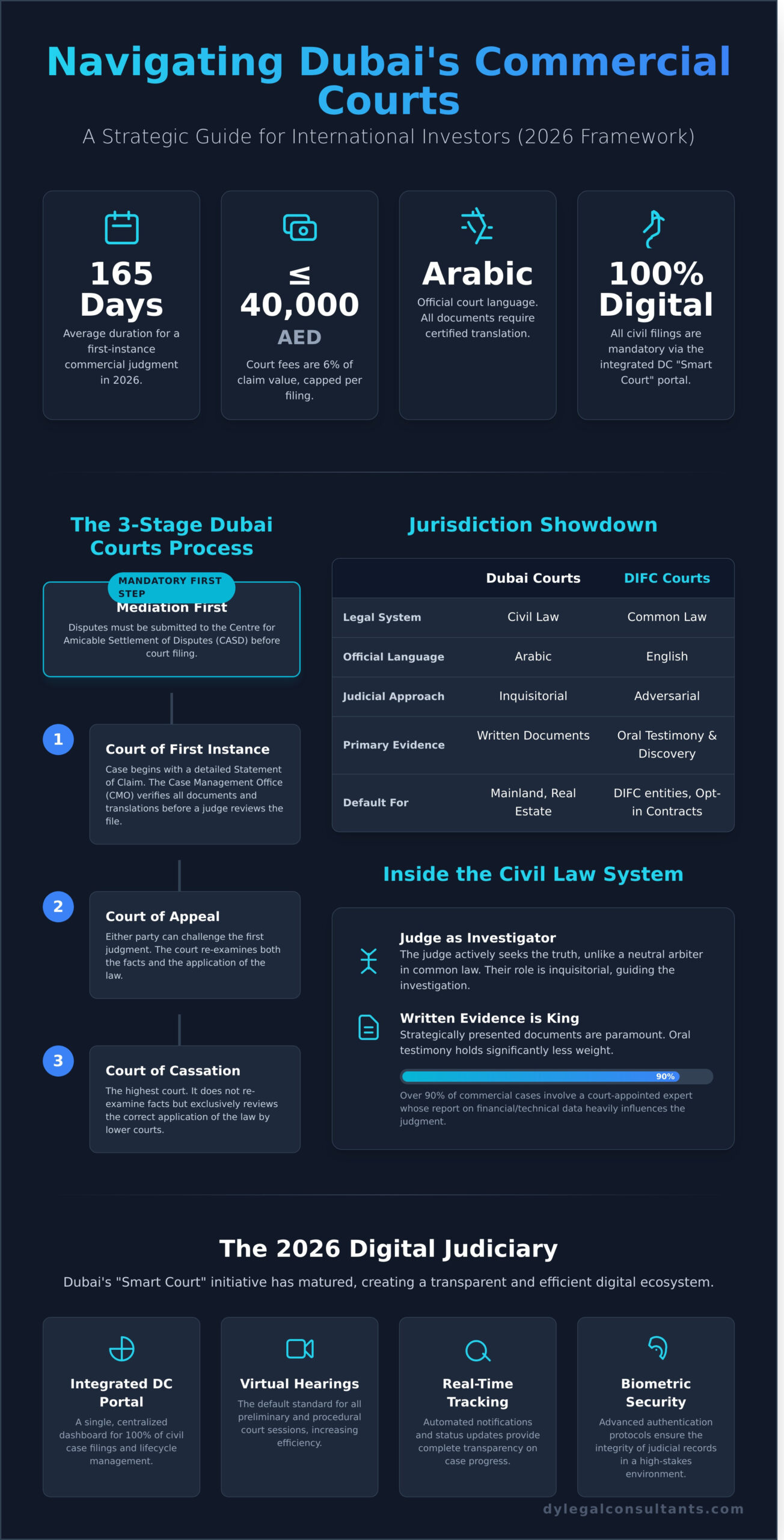
Language remains a cornerstone of the system. Arabic is the official language for all pleadings and oral arguments. Every piece of evidence, from emails to multi-page contracts, requires a formal translation by a Ministry of Justice licensed translator before submission. This requirement isn’t a mere formality; it’s a strategic necessity. Precision in translation prevents the misinterpretation of bespoke commercial terms during the dubai courts process. Additionally, your judicial path is often determined long before a dispute arises through the “Choice of Law” clause in your contract. While the DIFC Courts offer a common law alternative, the Dubai Courts remain the default jurisdiction for most mainland entities and real estate matters, applying UAE Federal Laws and local decrees.
The Civil Law Basis of Dubai Courts
The UAE follows a civil law system, which differs fundamentally from the adversarial nature of English or American common law. In this framework, the judge acts as the primary investigator. They don’t simply sit as a neutral arbiter of two competing arguments; they actively seek the truth through an inquisitorial approach. Written evidence is the undisputed king of the courtroom. In over 90% of commercial cases, the judge will appoint an independent expert from a registered roster to review financial records or technical data. The expert’s report often dictates the final judgment, making the strategic presentation of documents far more critical than theatrical oral testimony.
The 2026 Digital Judiciary Initiative
The “Smart Court” initiative has reached full maturity in 2026, mandating that 100% of civil filings occur through the integrated DC portal. This shift has standardized the litigation timeline, reducing the average duration of a first-instance commercial case to approximately 165 days. Virtual hearings are now the default for all preliminary and procedural sessions. Users manage their entire case lifecycle via a centralized dashboard, which provides real-time status updates and automated notifications for hearing dates. This digital transparency eliminates the historical “black box” of litigation, allowing businesses to track their legal standing with the same precision they track their logistics or financial portfolios. Security is maintained through advanced biometric authentication, ensuring that the integrity of the judicial record remains uncompromised in a high-stakes corporate environment.
Navigating this landscape requires more than just a procedural understanding; it demands a proactive strategy. At DY Lawyers and Legal Consultants, we view the legal framework not as a hurdle, but as a strategic asset. By aligning your corporate structure with the nuances of the Dubai Courts, you create a foundation of compliance that supports long-term growth and market confidence. Our boutique approach ensures that your case is handled with the intellectual sharpess and personalized care required to succeed in the UAE’s sophisticated regulatory environment.
The 3 Stages of the Dubai Courts Process
The dubai courts process follows a rigorous, three-tier hierarchy designed to ensure every litigant receives a fair and transparent hearing. This structure provides a predictable roadmap for resolving disputes, beginning with the Case Management Office (CMO). The CMO acts as a strategic filter, ensuring documents are complete and legal translations are accurate before a judge ever reviews the file. This procedural step has successfully reduced average case durations by approximately 22% since the implementation of the updated Civil Procedure Law in late 2022. It’s a system built for efficiency, allowing judges to focus on the merits of a case rather than administrative delays.
Filing and the Court of First Instance
The journey starts with the Statement of Claim. Precision is non-negotiable here because your initial filing sets the boundaries for the entire litigation. A vague claim often leads to immediate dismissal or costly delays. You’ll need to account for court fees, which generally amount to 6% of the claim value, with a maximum cap of AED 40,000 for most civil suits. Once the court accepts the filing, it serves a formal summons to the defendant. In technical disputes involving construction or complex finance, the court frequently appoints an independent expert. These experts provide a technical report that often forms the backbone of the judge’s final decision. While some international entities prefer the DIFC Courts jurisdiction for its common-law approach, the local Dubai Courts remain the primary venue for most mainland commercial activities.
Appealing the Judgment
If the initial verdict is unsatisfactory, the Court of Appeal offers a comprehensive review. The 30-day window for filing an appeal is the most critical factor to track. Missing this deadline usually means the right to challenge the judgment is lost forever. This stage isn’t a mere formality; it’s a de novo review where the court examines both factual findings and legal interpretations. You can challenge how the first judge weighed the evidence or point out procedural errors. It’s important to realize that filing an appeal doesn’t automatically stop the execution of the first judgment. If you want to prevent the immediate transfer of funds or seizure of assets, you must file a specific application to stay the execution during the dubai courts process.
The Court of Cassation: Finality
The Court of Cassation is the ultimate authority in the UAE judicial system. It doesn’t re-examine evidence or hear new witnesses. Instead, it focuses exclusively on whether the lower courts applied the law correctly. To qualify for this stage, the claim value must typically exceed AED 500,000. You have a 60-day deadline to file a Cassation petition, which provides a broader window for legal teams to refine their arguments compared to the appeal stage. This tier represents the final safeguard for judicial integrity. It ensures that legal principles are applied consistently across the landscape of Dubai’s commercial sector. Our boutique firm provides a strategic framework for litigation that ensures your interests are protected through every one of these critical stages.
Mandatory Mediation: The Centre for Amicable Settlement of Disputes
Dubai’s legal framework prioritizes resolution over prolonged conflict. Before a judge ever reviews your case file, the Centre for Amicable Settlement of Disputes acts as a mandatory filter for most civil and commercial claims. This “mediation first” approach is a cornerstone of the dubai courts process, designed to resolve conflicts in a fraction of the time required for full-scale litigation. By diverting cases to this specialized centre, the judiciary maintains its focus on high-complexity matters while offering parties a faster, more collaborative path to justice.
The Dubai Legal Affairs Department provides the regulatory oversight that ensures these proceedings meet international standards of fairness and professional conduct. When parties reach an agreement at the Centre, the settlement is documented and signed by a specialized judge. This document isn’t just a contract; it’s an executive deed. It carries the same legal weight as a final court judgment. If one party fails to honor the terms, the other can move directly to the execution phase without a new trial. This provides a level of security that traditional private settlements often lack.
Our experience shows that approximately 60% of disputes referred to the Centre reach a successful conclusion. This success rate stems from the structured environment where neutral mediators facilitate dialogue. It’s a bespoke environment where business leaders can speak freely, knowing that the discussions cannot be used against them if the case eventually moves to trial. We view this stage as a strategic asset for our clients, allowing for creative solutions that a rigid court judgment might not provide.
The Reconciliation Process Explained
Speed is the primary advantage here. The mediation window is typically restricted to a 15 to 30-day period. While the mediator facilitates the conversation, they don’t act as your advocate. Your legal consultant remains the architect of your strategy, ensuring that any proposed settlement aligns with your long-term commercial goals. If the parties remain at an impasse after these sessions, the Centre issues a “No Settlement” certificate. This certificate is a prerequisite for the next stage of the dubai courts process, officially allowing you to file the case before the Court of First Instance.
Strategic Settlement in Dubai
We advise clients to weigh the cost-benefit of an early resolution against the reality of a multi-year legal battle. Litigation in the UAE can span 12 to 18 months across three tiers of court. Settling at the Centre often entitles the claimant to a 50% refund of the court fees already paid, representing a direct financial incentive for pragmatism. Furthermore, mediation sessions are strictly confidential. For high-profile corporations, this protects the brand from the public scrutiny of open court hearings. If your contract includes specific clauses for private resolution, you may also explore arbitration & mediation as a tailored alternative to the public system. Choosing to settle early isn’t a sign of weakness; it’s a sophisticated business decision that prioritizes liquidity and operational focus over terminal litigation.
Dubai Courts vs. DIFC Courts: Selecting the Right Jurisdiction
Choosing the correct forum for your dispute is a strategic decision that impacts the trajectory of your legal journey. The UAE offers a unique dual-jurisdiction system within Dubai. You have the Dubai Courts, which operate under a civil law framework and use Arabic as the official language. Then there’s the Dubai International Financial Centre (DIFC) Courts, an independent, English-language system based on common law principles. Understanding how these systems interact is a fundamental part of the dubai courts process for any business leader.
This choice between legal systems is a critical strategic consideration for international businesses. For instance, the common law principles found in the DIFC are similar to those in the United States, where boutique firms like the Law Offices of Michael D. Payne specialize in navigating complex litigation within that specific framework.
This challenge of choosing the right legal framework is a familiar one for English-speaking businesses operating abroad. In other key international hubs, similar specialized legal support is essential. For example, for expatriates and investors navigating the legal system in Israel, the SALIOR Law Office provides dedicated representation for English-speaking clients.
Mainland companies aren’t strictly confined to local courts. Since the issuance of Decree No. 16 of 2011, parties can “opt-in” to the DIFC jurisdiction even if their contract has no physical connection to the free zone. This choice is often driven by the nature of the transaction. If your contract involves complex international financial instruments, the common law approach of the DIFC might feel more familiar. However, for local matters, the Dubai Courts offer deep-rooted expertise in regional statutes.
Cost structures vary significantly between the two. Dubai Court fees for civil claims are generally capped at AED 40,000 for the first instance. In contrast, DIFC Court fees are often calculated as a percentage of the claim value, which can exceed this cap for high-value disputes. Beyond court fees, legal representation costs in the DIFC often align with international hourly rates. Our boutique approach helps clients balance these expenses against the potential recovery value, ensuring the strategy remains commercially viable.
Commercial Advantages of Each System
Dubai Courts remain the primary choice for real estate disputes involving the Dubai Land Department or local employment matters governed by the UAE Labor Law. Their procedures are tailored to the local regulatory environment. For complex cross-border transactions or private equity disputes, the DIFC provides a predictable common law framework. Selecting the right venue is the first step in effective commercial litigation dubai, as it dictates the rules of evidence and the speed of the trial.
The Enforcement Landscape
A judgment is only as valuable as your ability to collect on it. The Execution Court within the Dubai Courts system is the engine that turns a paper victory into recovered assets. Through a 2014 Memorandum of Understanding, judgments move between the two systems with relative ease. If you hold a DIFC judgment but the debtor’s assets are in mainland Dubai, you can transfer that judgment for execution through the local courts. This synergy is vital when you need to enforce foreign judgment uae protocols effectively. Looking ahead, the 2026 enforcement protocols are expected to further streamline how cross-border assets are frozen and seized, adding another layer of security for creditors within the dubai courts process.
Deciding between civil and common law jurisdictions requires a bespoke analysis of your specific contract and risk profile. Contact our strategic advisors to determine which court system offers the most robust protection for your commercial interests.
Boutique Advocacy: How DY Lawyers Navigates the Landscape
Filing a lawsuit is merely the mechanical start of a much deeper strategic journey. While the dubai courts process follows a structured digital path, the difference between a favorable judgment and a costly dismissal lies in the nuances of the strategy. DY Lawyers moves beyond generic procedural filing to offer a bespoke approach. We treat every commercial dispute as a unique challenge that requires a surgical touch rather than a one-size-fits-all template. Our firm prioritizes the quality of legal arguments over the volume of cases, ensuring that your specific business objectives remain at the forefront of every motion filed.
High-stakes commercial cases, particularly those involving claims exceeding 5,000,000 AED, demand meticulous document management. The Dubai Courts operate through a sophisticated digital infrastructure where compliance is strictly enforced. A single error in a notarized translation or a late submission in the Smart Petition system can result in delays lasting 15 to 20 business days. We provide end-to-end management of these administrative hurdles. This precision allows our clients to focus on their core operations while we handle the technical rigors of the judicial system. Our boutique advantage means you receive personalized attention from senior legal consultants who understand the weight of your investment.
Strategic foresight is our primary tool for risk mitigation. We identify potential bottlenecks before they ever reach the Court of First Instance. By analyzing the 12-month history of similar rulings in the UAE, we anticipate how a judge might interpret specific contractual clauses. This proactive stance ensures that we aren’t just reacting to the court’s demands; we’re shaping the narrative of the case from the initial notification. We believe that a well-prepared case often resolves itself before a final trial, saving both time and capital.
Our deep integration into Dubai’s corporate ecosystem extends beyond the courtroom. We understand that a company’s public image and professional relationships, often showcased at major corporate and media events, are as vital as its legal standing. Capturing these moments professionally is part of building a strong corporate narrative, a service expertly provided by specialists like Constantin Photography.
Our Proactive Approach to Litigation
Success in the local judiciary requires more than just legal knowledge; it demands a mastery of the Arabic-language proceedings that define the dubai courts process. All submissions, from the initial statement of claim to the final memorandum, must be articulated in precise legal Arabic. Our team leverages deep local expertise to ensure your position is never lost in translation. We conduct rigorous legal due diligence before filing, assessing the strength of evidence such as bank statements, correspondence, and technical reports. In 2023, this methodical preparation helped a major developer resolve a 3,200,000 AED construction dispute in Business Bay by identifying a critical oversight in the opposing party’s performance bond documentation.
Securing Your Business Interests
We believe a solution-driven mindset is far more effective than traditional legal aggression. While we’re decisive advocates in the courtroom, our goal is to secure your interests with the least amount of friction possible. This often involves negotiating settlements that preserve commercial relationships while ensuring regulatory compliance. Partnering with DY Lawyers provides you with a long-term strategic asset rather than a temporary service. We help you build a framework of integrity and compliance that prevents future litigation. If you’re facing a complex legal challenge, book a strategic consultation with our Dubai legal experts to explore your options and secure your professional future.
Mastering Your Legal Strategy for 2026 and Beyond
Success within the dubai courts process hinges on mastering the three-stage litigation framework and leveraging mandatory mediation at the Centre for Amicable Settlement of Disputes. As we move through 2026, the ability to distinguish between the civil law requirements of Dubai Courts and the common law environment of the DIFC is vital for protecting your corporate assets. It’s not just about resolving a conflict; it’s about positioning your firm for long-term stability in a fast-paced global market.
DY Lawyers provides the boutique legal expertise your business needs from our specialized office in Business Bay. We’re specialists in Real Estate and Construction Law with a proven track record in high-value commercial litigation, frequently managing complex claims exceeding AED 15 million. We don’t just identify risks; we create clear pathways to resolution that prioritize your commercial timelines and bottom line. Secure your business interests with a strategic consultation at DY Lawyers. We’re ready to act as your dedicated advocate and navigate the complexities of the UAE legal landscape together.
Frequently Asked Questions
How long does the typical Dubai Courts process take for commercial cases?
A typical commercial litigation case within the dubai courts process generally concludes within 6 to 12 months at the Court of First Instance. This timeline depends on the complexity of the evidence and the number of hearings required. Recent judicial reforms from 2023 aim to expedite these timelines through digital transformation. We ensure your case moves efficiently by managing all procedural filings with precision to avoid unnecessary delays.
Do I need to attend court hearings in person in Dubai?
You don’t usually need to attend hearings in person because Dubai Courts transitioned to a fully digital litigation system in 2020. Most proceedings occur via remote video conferencing or through written submissions on the smart portal. Your legal representative handles the technicalities; however, the judge might request your presence for specific testimony. This digital framework provides a seamless experience for international clients managing disputes from abroad.
What are the court fees for filing a civil case in Dubai?
Filing a civil case requires a fee of 6% of the total claim value. For most commercial claims, this amount is capped at AED 40,000 at the Court of First Instance. You’ll also encounter smaller administrative costs, such as the AED 500 fee for the knowledge and innovation dirham. We provide a bespoke fee breakdown during our initial consultation to ensure your legal budget remains predictable and strategic.
Can I use English documents in the Dubai Courts?
You can’t submit documents in English directly as Arabic is the official language of the Dubai Courts. Every piece of evidence must be translated by a UAE Ministry of Justice licensed legal translator. We manage this translation process to ensure the technical nuances of your commercial contracts remain intact. This step is a vital part of the dubai courts process to ensure your evidence is admissible and clear.
What happens if the defendant is outside the UAE during the process?
If a defendant resides outside the UAE, the court initiates a formal notification process through diplomatic channels or international treaties. This procedure can add 3 to 6 months to your timeline depending on the country involved. If their address is unknown, the court permits notification through publication in local newspapers. We navigate these cross-border complexities to ensure the litigation remains on a steady and legally sound path.
Is the mediation stage at the Amicable Settlement Centre compulsory?
Mediation at the Centre for Amicable Settlement of Disputes is compulsory for most civil and commercial claims below AED 500,000. This mandatory stage lasts up to 30 days and aims to resolve conflicts without formal litigation. It’s a strategic opportunity to reach a settlement that protects your interests while saving time. If no agreement is reached, the center issues a referral letter to proceed to the main court.
How do I enforce a Dubai Court judgment if the debtor refuses to pay?
You must file an execution file with the Execution Department once a judgment becomes final. The court has the power to freeze bank accounts, seize assets, or even impose travel bans on the debtor to ensure compliance. Statistics show that proactive enforcement actions lead to higher recovery rates for corporate creditors. We act as your decisive advocate during this phase to turn your legal victory into tangible financial recovery.
