

What if the RERA Rental Index suggests your rent can jump by 20%, yet your specific contract terms offer a different protection? For many in the UAE, the dubai leasing law feels like a moving target, especially as the 2026 regulatory updates take hold. You likely feel that the RERA calculator doesn’t always reflect the reality of your specific sub-community or building quality. We understand that the fear of a sudden AED 15,000 increase or the anxiety of paying 3.5% of your annual rent in RDC filing fees can be paralyzing.
Our boutique legal framework replaces that uncertainty with strategic clarity. You’ll master the complexities of the latest RERA regulations, learn the precise limits for rent increases, and discover how to resolve disputes with calm confidence. We provide a step-by-step guide to defending your position and drafting compliant tenancy contracts that serve as a strategic asset for your property goals. This guide ensures you navigate the current landscape with the foresight required to protect your interests in Dubai’s evolving market.
Key Takeaways
- Gain a comprehensive understanding of Law No. 26 of 2007 and Law No. 33 of 2008 to navigate the evolving dubai leasing law with strategic clarity and confidence.
- Learn to utilize the RERA Rental Price Index and the mandatory 90-day notice period to effectively manage rent increases and minimize financial exposure.
- Identify the specific legal boundaries of maintenance and property care to ensure both landlords and tenants fulfill their contractual obligations seamlessly.
- Discover the structured procedures of the Rental Dispute Center (RDC) to resolve conflicts efficiently and protect your rights within the Dubai Land Department framework.
- Recognize the value of bespoke legal counsel in providing end-to-end lease management and safeguarding high-value property assets in the competitive UAE market.
The Evolution of Dubai Leasing Law: Navigating the 2026 Framework
Dubai’s real estate sector has transitioned from a burgeoning market into a highly regulated global benchmark. For investors and residents, the dubai leasing law provides a structured environment that balances the protection of capital with the rights of the occupier. The legal foundation rests upon Law No. 26 of 2007, which was significantly refined by Law No. 33 of 2008 to address early market ambiguities regarding lease renewals and eviction notices. These statutes don’t just exist as static rules; they’re dynamic tools that reflect the city’s commitment to transparency and judicial efficiency.
The current 2026 market operates with a level of sophistication that requires more than a casual understanding of these laws. While the “Unified Tenancy Contract” introduced by the authorities provides a standardized template, it’s a baseline rather than a total legal shield. Sophisticated parties often incorporate bespoke addendums to cover specific maintenance thresholds or early termination penalties. These additions must remain compliant with the overarching dubai leasing law, as any clause that contradicts the primary legislation is typically rendered void by the Rental Dispute Centre (RDC).
Core Legislation and RERA’s Regulatory Mandate
The governance of Dubai’s rental market is a collaborative effort between the Dubai Land Department (DLD) and its regulatory arm. The Dubai Real Estate Regulatory Agency (RERA) functions as the primary watchdog, ensuring that all market participants adhere to the established codes of conduct. Law No. 26 of 2007 constitutes the primary regulatory authority governing the contractual relationship between landlords and tenants, establishing the legal baseline for lease terms, maintenance responsibilities, and eviction protocols across Dubai.
Registration via the Ejari system is a non-negotiable requirement for all leasehold interests. It’s the only way to transform a private agreement into a legally recognized document. Without an Ejari certificate, tenants can’t connect basic DEWA services or sponsor family visas. More importantly, the RDC won’t hear a case unless the lease is registered. This system ensures that the DLD maintains an accurate database of rental prices, which in turn fuels the RERA Rent Index. It’s a closed-loop system designed to prevent arbitrary price hikes and ensure market stability.
Recent Regulatory Shifts in 2026
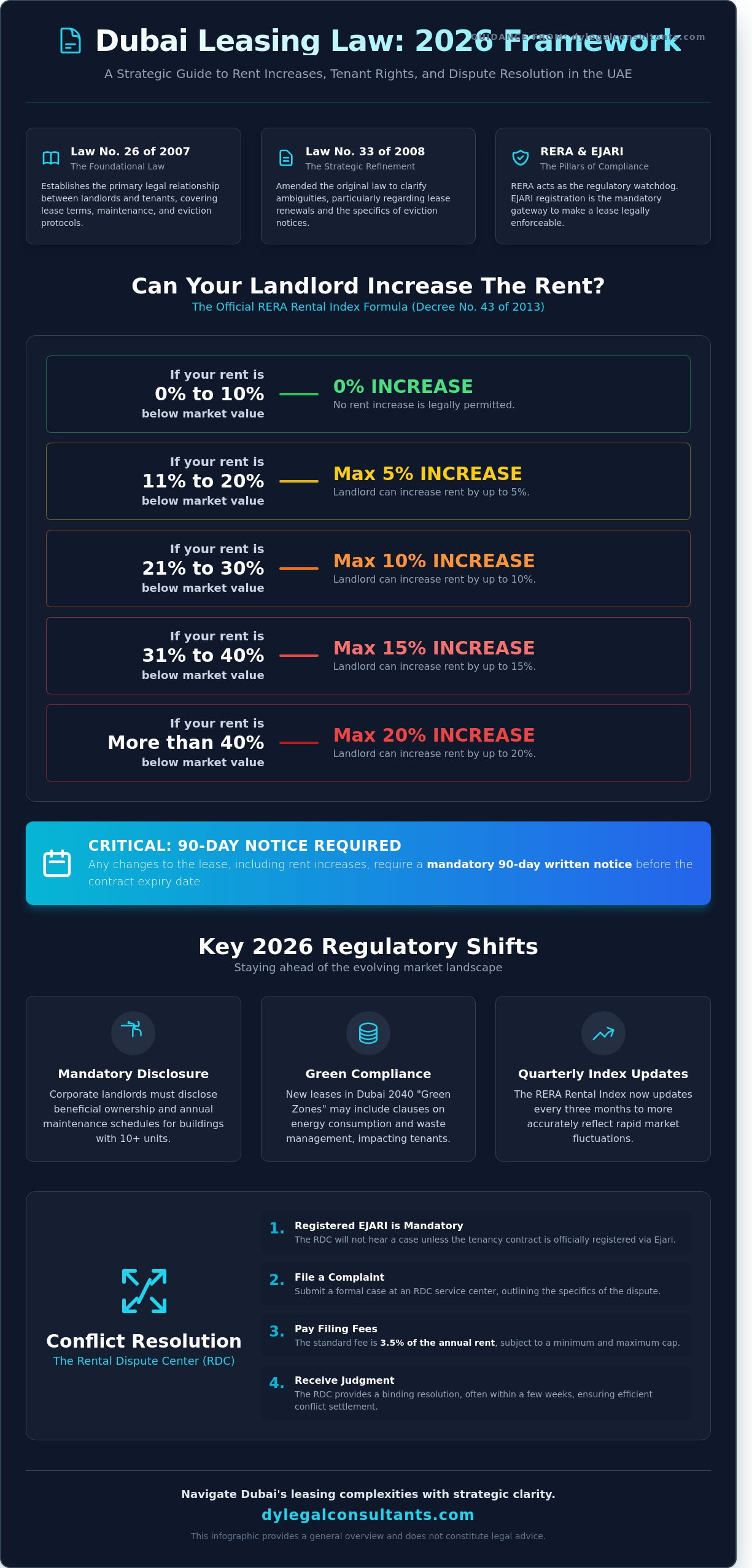
Current judicial interpretations in 2026 have been heavily influenced by Decree No. 43 of 2013, which governs rent increases. The RERA calculator remains the final word on whether a landlord can demand a higher rate upon renewal. If the current rent is within 10% of the market average, no increase is permitted. As of January 2026, new transparency requirements demand that corporate landlords provide detailed disclosures regarding their beneficial ownership and management structures during the Ejari registration process. This move aims to increase accountability in the commercial and high-end residential sectors.
The Dubai 2040 Urban Master Plan is also beginning to reshape leasing rights through strategic rezoning. We’ve seen a 15% increase in mixed-use designations in areas previously considered strictly residential. These shifts affect everything from service charge allocations to the types of businesses a tenant can operate from a leased premises. Key developments include:
- Mandatory Disclosure: Corporate entities must now disclose annual maintenance schedules to tenants in buildings exceeding 10 units.
- Green Compliance: New leases in 2040-designated “Green Zones” often include clauses regarding energy consumption and waste management.
- Rent Caps: The RERA Index now updates quarterly to reflect the rapid 2026 market movements, ensuring the AED 5,000 to AED 10,000 fluctuations in mid-market areas are captured accurately.
Understanding these nuances is a strategic asset. It allows landlords to protect their yields while ensuring tenants enjoy the security of tenure that Dubai’s legal framework is designed to provide.
Rent Increases and the RERA Calculator: Managing Your Financial Exposure
Proactive financial planning is the cornerstone of a successful tenancy or property investment in the UAE. Understanding the specific mechanics of the dubai leasing law ensures that neither party is caught off guard by sudden market shifts. The legal framework provides a predictable structure, turning potential conflicts into manageable administrative processes that protect your bottom line. It’s about moving beyond guesswork and utilizing the official tools provided by the government to maintain equilibrium.
The 90-Day Notice Requirement
Strict adherence to Article 14 of Law No. 33 of 2008 is vital for any proposed amendment to a lease contract. Landlords must provide a written notice at least 90 days before the contract expires if they intend to increase the rent or alter any terms. This notice isn’t just a courtesy; it’s a legal mandate that requires delivery via registered mail or a notarized document to be enforceable. If a landlord fails to meet this 90-day threshold, the lease automatically renews under the existing terms and price. Tenants can legally challenge any late notice by filing a case with the Rental Dispute Center. This prevents arbitrary changes and gives both parties ample time to evaluate their options. Failure to provide this notice in the correct format often renders the increase void, regardless of market conditions.
Utilizing the RERA Rent Increase Calculator
The RERA Rental Price Index serves as the benchmark for all residential and commercial increases. It eliminates guesswork by providing a transparent percentage-based system. The calculator operates on specific tiers. A 5% increase is permitted if the rent is 11% to 20% below the market average. A 10% increase applies if the rent is 21% to 30% below. If the gap is 31% to 40% below, a 15% increase is allowed. The maximum cap is 20% for any rent that is more than 40% below the current market average. Many people mistakenly believe they can charge the current market rate immediately, but the law prioritizes gradual adjustments. The RERA calculator acts as the final arbiter of rent increases in the absence of mutual agreement between the parties.
While the index is the primary tool, unique property features sometimes justify a deviation. In such cases, a Rent Valuation Certificate from the Dubai Land Department provides a formal, unit-specific assessment. This certificate can supersede the general index if the property offers exceptional amenities or has undergone significant upgrades recently. Strategic timing is essential. Parties should initiate these valuations at least 120 days before renewal to allow for informed negotiations. Relying on data-driven insights rather than emotional bargaining protects your interests and fosters a professional relationship. For those seeking to safeguard their portfolio or residential stability, securing bespoke legal advice can prevent costly litigation. This approach ensures full compliance with the evolving dubai leasing law while providing a clear roadmap for your financial future. Maintaining a clear paper trail and respecting statutory deadlines creates a seamless transition during every renewal cycle.
Contractual Rights and Obligations: A Strategic Comparison
Understanding the nuances of dubai leasing law requires more than a glance at the standard Ejari form. It’s a strategic exercise in risk mitigation. Landlords hold the primary responsibility for maintaining the property’s structural integrity, ensuring that the premises remain habitable throughout the lease. They must guarantee “quiet enjoyment,” which means they can’t enter the premises without prior notice or a valid reason. Tenants, conversely, are bound by the duty of care. They must pay rent on time and use the property only for its intended purpose as stated in the contract.
While the Ejari system provides a unified template, the “Additional Terms” section is where most legal friction originates. These bespoke clauses often attempt to shift maintenance costs or bypass statutory notice periods. If these terms conflict with the overarching dubai leasing law, specifically Law No. 33 of 2008, they’re likely void. Relying on professional Contract Drafting and Review Services is the only way to ensure your specific requirements are both enforceable and fair under UAE regulations.
When communication breaks down, the Rental Dispute Center (RDC) serves as the final arbiter. Their rulings are based on strict adherence to the law, often penalizing parties who ignore their contractual obligations or attempt unfair security deposit deductions. In 2023, the RDC processed thousands of cases, highlighting the need for clear, legally vetted agreements from the outset.
Maintenance and Property Standards
The distinction between minor and major maintenance is a common battleground. Generally, landlords handle structural repairs and primary systems like central air conditioning. Tenants typically cover wear and tear items under a specific value, often set at a threshold of AED 500 or AED 1,000 per instance. Documentation is your strongest shield. A comprehensive move-in report with high-resolution photos ensures that the security deposit is protected from unjust claims at the end of the term. If a landlord fails to address a major defect that makes the property uninhabitable, the tenant may have grounds to seek a rent reduction through the RDC.
Usage Restrictions and Subletting
Property use is non-negotiable under Dubai’s zoning regulations. Changing a residential unit into a commercial space without authorization triggers heavy fines and potential eviction. In high-density districts like Business Bay, commercial compliance involves verifying trade licenses against the lease’s permitted activity. Subletting remains strictly prohibited unless the landlord provides explicit, written consent. Violating this rule is one of the few ways a tenant can be legally evicted before their contract expires. For businesses, ensuring the lease aligns with their specific commercial activity is a vital step in maintaining long-term operational stability.
Security deposit management shouldn’t be an afterthought. Landlords often try to deduct for “repainting” or “deep cleaning” at the end of a lease. However, the law protects tenants against charges for normal usage. Clear communication and a joint inspection at the end of the tenancy are essential. If a landlord refuses to return a deposit without valid receipts for repairs, the tenant’s next step is filing a formal complaint. This proactive approach ensures that both parties fulfill their roles with integrity and transparency.
Resolving Conflicts: The Rental Dispute Center (RDC) Procedure
Negotiation often reaches a stalemate when one party fails to uphold their obligations under the dubai leasing law. This represents the “Point of No Return.” It’s the moment when informal discussions no longer protect your interests and formal litigation becomes the only viable path. The Rental Dispute Center (RDC), the judicial arm of the Dubai Land Department, provides a specialized framework to resolve these tensions with precision and speed. It moves away from the traditional court system to offer a streamlined, four-tier process designed specifically for the real estate sector.
The RDC structure prioritizes resolution over prolonged conflict. The journey starts at the Conciliation Department, where mediators attempt to reach a settlement within 15 days. If this fails, the case graduates to the Department of First Instance. For disputes where the value exceeds AED 50,000, parties have the right to move to the Department of Appeal. The final stage is the Execution Department, which is responsible for the actual recovery of funds or the enforcement of eviction orders. This tiered approach ensures that most cases find a solution before reaching a full trial.
Filing a Case: Documentation and Fees
Success at the RDC depends on the integrity of your evidence. You’ll need a registered Ejari certificate, clear copies of all correspondence, and bank statements proving payment or default. Filing fees are calculated at 3.5% of the annual rent, with a minimum of AED 500 and a cap of AED 20,000 for financial claims. The Conciliation Department plays a vital role here; it currently settles approximately 40% of all filed disputes, allowing parties to avoid the higher costs and time commitment of a full hearing.
Eviction Grounds and Legal Defenses
Landlords frequently invoke Article 25 of Law No. (33) of 2008 to regain possession of their property. As we move through the 2026 market, we’ve observed a rise in “Bad Faith” eviction defenses. Tenants are increasingly challenging landlords who claim they need the property for personal use but actually intend to re-list it at a higher market rate. Eviction for personal use requires a notarized 12-month notice period to be legally valid. If a landlord re-lets the property within two years of such an eviction, the previous tenant can claim significant damages through the RDC.
Turning a legal victory into a recovery requires the Execution Department’s intervention. Once a judgment is final, the RDC has the power to garnish bank accounts, block government transactions for the debtor, or coordinate with police for physical evictions. This robust enforcement mechanism ensures that a win on paper translates into a strategic result for the client. Navigating these procedural nuances requires a partner who understands the local landscape and the evolving dubai leasing law requirements.
If you’re facing an intractable rental conflict, our boutique team provides the strategic clarity you need. Consult with DY Legal Consultants today to protect your property rights and secure a decisive resolution.
Strategic Asset Protection: Secure Your Your Lease with DY Lawyers
High-value commercial leases in prime districts like DIFC or Business Bay often involve annual commitments exceeding AED 1,500,000. Relying on standard Ejari templates for such significant investments is a risk that sophisticated entities can’t afford. DY Lawyers and Legal Consultants provides the boutique oversight necessary to treat a lease as a strategic business asset rather than a mere administrative hurdle. We align your contractual obligations with the specific nuances of dubai leasing law to ensure your operational continuity remains protected against market volatility.
Our end-to-end management covers the
Transform Your Property Strategy for 2026
Navigating the updated dubai leasing law requires more than just a basic understanding of your tenancy contract. The 2026 framework solidifies the role of the RERA rent calculator as the primary benchmark for adjustments, ensuring that all financial escalations remain within legal thresholds set by the Dubai Land Department. Landlords and tenants must prioritize accurate documentation to mitigate risks before the Rental Dispute Center. It’s not just about compliance; it’s about turning these regulations into a strategic asset for your real estate portfolio.
DY Legal Consultants provides the boutique attentive service you need to navigate these complexities. Our deep expertise in Dubai Land Department regulations ensures your contracts are resilient, while our solution-driven litigation strategy protects your interests during active disputes. We don’t just identify problems; we architect the solutions that secure your future in the UAE market. You’ve got the tools to thrive in this evolving environment.
Secure your property interests with a strategic legal consultation
Frequently Asked Questions
Can a landlord increase the rent in Dubai without using the RERA calculator?
No, a landlord cannot legally increase rent beyond the limits set by the RERA Rental Price Index. Decree No. 43 of 2013 mandates that any increase must align with this official calculator. Landlords must also provide a formal 90 day notice before the contract expires. This structured approach ensures transparency within the dubai leasing law framework, protecting your financial interests through clear regulatory compliance.
What is the minimum notice period for an eviction in Dubai?
The minimum notice period for a standard eviction in Dubai is 12 months. According to Law No. 33 of 2008, this notice must be delivered via Notary Public or registered mail to be legally binding. It’s a strategic safeguard that provides tenants ample time to secure new premises. We ensure our clients navigate this timeline with precision to avoid costly delays or legal disputes.
Is the Ejari unified contract enough to protect my commercial interests?
While the Ejari unified contract provides a foundational legal framework, it’s rarely sufficient for complex commercial arrangements. Businesses often require bespoke addendums to address specific operational needs like fit out periods, sub leasing rights, or detailed maintenance obligations. Our boutique approach focuses on drafting these additional clauses to ensure your commercial interests remain fully protected and legally enforceable under dubai leasing law.
What happens if I don’t register my tenancy contract with Ejari?
Failing to register your contract with Ejari leaves you without legal standing at the Rental Dispute Center. Under Law No. 26 of 2007, an unregistered lease isn’t recognized by Dubai government entities, preventing you from accessing essential services like DEWA or internet connections. This lack of registration creates a significant risk, as you won’t have a formal mechanism to resolve conflicts or enforce your rights.
Can a tenant terminate a lease early in Dubai without penalty?
A tenant cannot typically terminate a lease early without a penalty unless a specific break clause is included in the contract. Most standard agreements in Dubai require a penalty payment of 2 months’ rent for an early exit. We recommend negotiating these terms during the initial drafting phase to provide a seamless exit strategy that aligns with your long term commercial or personal goals.
How much does it cost to file a case at the Rental Dispute Center?
Filing a case at the Rental Dispute Center costs 3.5% of the property’s annual rent. This fee is capped at a minimum of AED 500 and a maximum of AED 20,000 per claim. Additional administrative costs, such as knowledge and innovation fees, typically add around AED 520 to the total. Our team provides a clear breakdown of these costs to ensure your legal strategy remains budget conscious and effective.
Can a landlord enter my property without permission for inspections?
No, a landlord cannot enter your property without your explicit permission or prior notice. Dubai law protects a tenant’s right to quiet enjoyment of the premises. Unless it’s an emergency, landlords must provide at least 24 hours’ notice before conducting inspections or repairs. This professional boundary is essential for maintaining a respectful and legally compliant relationship between both parties in the local landscape.
What are the grounds for immediate eviction under Dubai Leasing Law?
Immediate eviction can occur under Article 25 of Law No. 33 of 2008 for specific breaches. These include failing to pay rent within 30 days of a formal notice, using the property for illegal activities, or sub letting without written consent. If a tenant causes damage that threatens the safety of the structure, the landlord has the right to seek eviction through the RDC. We provide the strategic foresight needed to manage these high stakes situations.
