

What if the difference between a standard exit and a strategic financial milestone came down to a single line item in your employment contract? While Federal Decree-Law No. 33 of 2021 revolutionized the workplace, many professionals still find themselves interpreting the dubai gratuity law with more questions than certainties. It’s common to feel a sense of unease when your hard-earned benefits are calculated behind closed doors, especially when the gap between basic and total salary can change your final payout by 15% or more.
We recognize that securing your end-of-service benefits is about more than just a check; it’s about the integrity of your professional journey in the UAE. This guide provides the clarity you need to master the 2026 regulations, ensuring your transition is both seamless and financially accurate. You’ll gain a bespoke understanding of how resignation affects your entitlements and learn the exact framework for filing a formal claim if your rights are ever compromised.
Key Takeaways
- Navigate the statutory framework of Federal Decree-Law No. 33 of 2021 to ensure your benefits align with the current dubai gratuity law standards for the 2026 landscape.
- Master the technical distinction between basic salary and total remuneration to calculate your 21-day or 30-day payout multipliers with absolute precision.
- Deconstruct common misconceptions regarding resignation to understand how the specific nature of your contract termination dictates your final AED settlement.
- Identify the essential documentation, such as the Salary Certificate, required to audit your employer’s offer and maintain rigorous compliance during the exit process.
- Learn when to transition from self-help to bespoke legal consultancy to resolve complex disputes through strategic MOHRE mediation and professional advocacy.
Understanding Dubai Gratuity Law in 2026: The Statutory Foundation
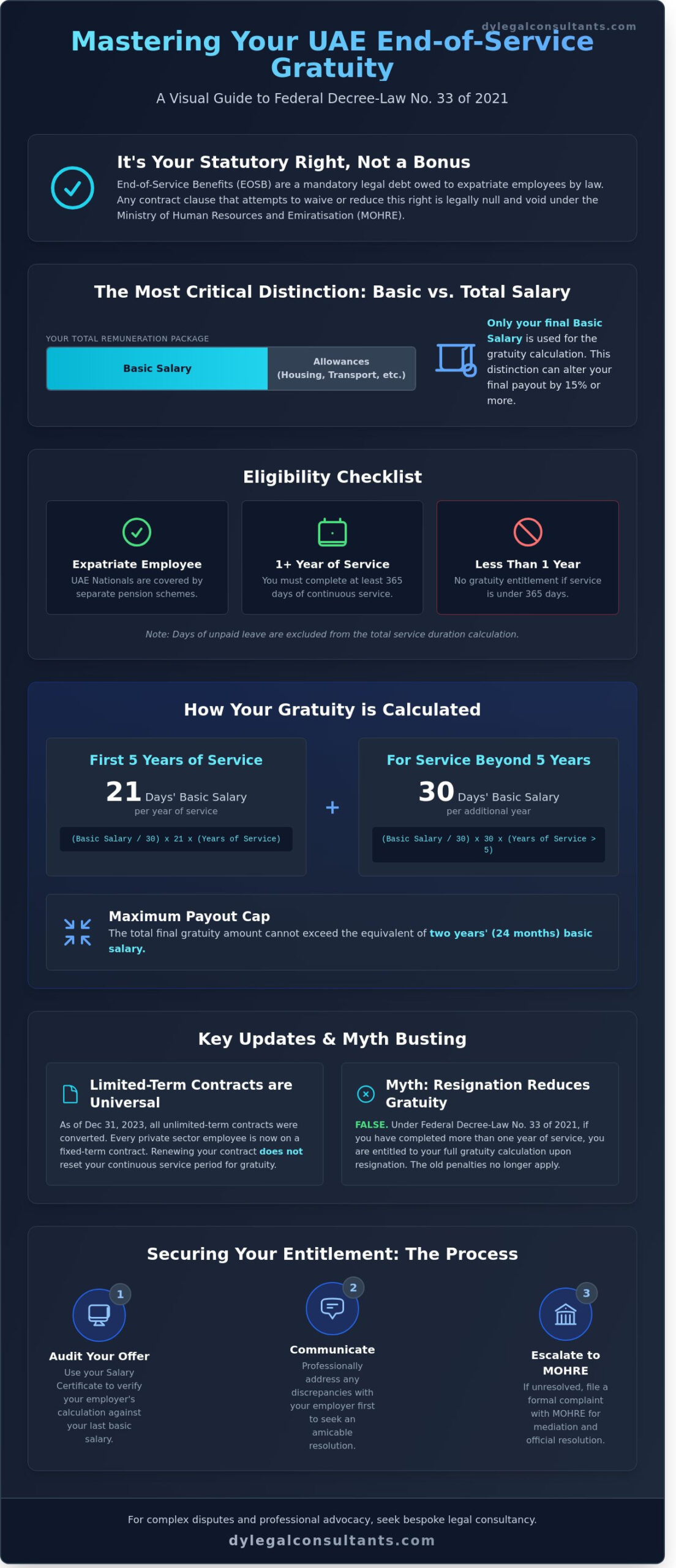
End-of-Service Benefits (EOSB), commonly referred to as gratuity, represent a statutory financial entitlement for expatriate employees in the UAE. This isn’t a discretionary bonus or a gift from the employer; it’s a legal debt accrued over the duration of an employment relationship. The dubai gratuity law serves as a critical pillar of the UAE’s labor framework, ensuring that professionals receive a lump-sum payment upon the termination or completion of their contract. This financial cushion is calculated based on the employee’s final basic salary, providing a strategic bridge during career transitions.
Federal Decree-Law No. 33 of 2021, which came into full effect on February 2, 2022, remains the definitive authority in the 2026 legal environment. This legislation modernized the workforce by standardizing rights across the private sector. The legal framework surrounding Migrant worker rights in the UAE ensures that every expatriate professional receives this protection, provided they meet the minimum service thresholds. While UAE nationals are covered by the General Pension and Social Security Authority (GPSSA) or local pension schemes, expatriates rely exclusively on the EOSB system for their end-of-service security.
Integrity in employment starts with the contract itself. Gratuity is a mandatory entitlement. You cannot waive your right to it in a side agreement or a bespoke employment contract. Any clause that attempts to bypass the dubai gratuity law is considered legally null and void by the Ministry of Human Resources and Emiratisation (MOHRE). DY Lawyers and Legal Consultants emphasizes that compliance isn’t just a hurdle; it’s a strategic asset that protects both the firm’s reputation and the employee’s future.
The Universal Shift to Limited-Term Contracts
By 2026, the transition from unlimited to limited-term contracts is entirely complete. The deadline for this conversion was December 31, 2023, meaning every private-sector employee now operates under a fixed-term arrangement. This shift has brought a sense of order to gratuity claims. Contract renewals don’t reset the clock on your service. Instead, they facilitate a seamless continuation of your tenure, ensuring your cumulative years of service are preserved for the final EOSB calculation. This structure provides a predictable framework for international business leaders managing regional teams.
Minimum Service Requirements for Eligibility
Eligibility for a gratuity payout begins precisely after one year of continuous service. If an employee leaves their position before completing 365 days, they aren’t entitled to any EOSB payout. It’s a binary threshold. Once that first year is surpassed, the entitlement is secured. However, the calculation of this service period is nuanced. Days of unpaid leave, or leave without pay, are excluded from the total service duration. For instance, if an employee takes 30 days of unpaid leave during their second year, those 30 days are deducted from the total count when determining the final payout amount.
Continuous service is the gold standard for eligibility. A break in employment occurs only if there is a formal termination followed by a significant gap before a new contract begins. Short administrative gaps during visa transfers typically don’t constitute a break in service if the employer remains the same. Our boutique approach at DY Lawyers and Legal Consultants ensures that these calculations are handled with precision, reflecting the exact reality of the employee’s history. Understanding these mechanics is vital for maintaining a stable and transparent corporate environment in Dubai’s competitive market.
Calculating the Payout: Basic Salary, Service Length, and Key Multipliers
Precision is the hallmark of the dubai gratuity law framework. To calculate your entitlement accurately, you must first isolate your basic salary from your total remuneration package. Most employment contracts in the UAE divide pay into a basic component and various allowances, such as housing, transport, or schooling. The law is clear: your end-of-service benefit is derived solely from your last drawn basic salary. This distinction is vital. It ensures that the benefit remains a predictable reflection of core earnings rather than a figure tied to variable or temporary perks. Transparency in your contract is the first step toward financial security.
The law also sets a definitive ceiling on these payouts. Your total gratuity amount can’t exceed the equivalent of two years of your basic salary. This cap provides a clear financial boundary for both parties, allowing for better long-term corporate provisioning and individual financial planning. If you leave your position mid-year, the law remains equitable. You’re entitled to a pro-rata payment for any fraction of a year served, provided you’ve completed the initial 12-month minimum service requirement. Calculations don’t just stop at the year mark; they account for every day you’ve contributed to the organization.
The 21-Day Rule for the First Five Years
The 21-day rule defines the payout for employees who have served between one and five years. The 21-day rule designates 21 days of basic salary for each year of service for the initial five years of a contract. This standard provides a stable foundation for expatriates building their careers in the region. It’s a structured approach that rewards the first phase of an employee’s journey with a clear, predictable formula.
Consider a mid-level professional in Dubai with a basic salary of AED 12,000, even if their total package is AED 20,000. If they resign after exactly four years of service, the calculation is straightforward. Their daily rate is AED 400 (AED 12,000 divided by 30). Under the dubai gratuity law, they’d receive 21 days for each of those four years. This results in a total payout of AED 33,600. Using a Guide to calculating end-of-service benefits can help you verify these figures against your specific contract terms.
The 30-Day Rule for Seniority
Once an employee crosses the five-year threshold, the multiplier increases to 30 days of basic salary for every year thereafter. It’s a tiered system designed to favor long-term seniority. The first five years of service are always calculated at the 21-day rate, while the sixth year and beyond benefit from the full month’s rate. This blended approach ensures that the total sum reflects the increasing value of a long-term professional relationship. It’s a strategic incentive for talent retention across the UAE’s competitive landscape.
It’s important to remember that commissions, bonuses, and discretionary allowances are generally excluded from this base. The focus remains strictly on the fixed basic salary stipulated in the original or amended labor contract. For executives with complex compensation structures, ensuring that the basic salary reflects their true seniority is a critical part of contract negotiation. If you’re unsure how your specific allowances impact your final figure, you might consider a bespoke contract review to ensure your interests are fully protected. This structured rhythm of 21 and 30 days provides a reliable anchor for everyone navigating the regional job market.
Navigating Contract Terminations: Resignation vs. Dismissal Impacts
One of the most persistent myths regarding dubai gratuity law is that resigning voluntarily leads to an automatic loss of benefits. This is a misconception that often creates unnecessary anxiety for professionals. Under the current legal architecture, your accrued end-of-service benefits are generally protected, regardless of whether you choose to move to a new opportunity or your employer initiates the separation. The framework has evolved to provide a more equitable landscape for the 90% of the UAE’s private sector workforce that is expatriate.
The reason for your termination dictates the final settlement structure, but it rarely results in a total forfeiture. Whether you are navigating a strategic career move or facing a sudden redundancy, understanding how the law treats these different exit paths is essential for your financial security. Our boutique approach at DY Legal Consultants ensures that every client understands these nuances as strategic assets rather than legal hurdles.
Resignation Under the New Labour Law
Federal Decree-Law No. 33 of 2021 represents a significant shift in how the UAE manages employment transitions. Previously, employees on “unlimited” contracts faced a sliding scale that could reduce their gratuity by two-thirds if they resigned before three years of service. Since the unified transition to fixed-term contracts was mandated for completion by December 31, 2023, these reductions have been abolished. You’re now entitled to your full calculated gratuity provided you’ve completed at least one year of continuous service.
Compliance with notice periods remains a vital pillar of the dubai gratuity law. If you fail to serve the notice period specified in your contract, which usually ranges from 30 to 90 days, you must pay “compensation in lieu of notice.” This amount equals the salary for the notice period or the remaining portion of it. It’s a bespoke calculation based on your last basic wage. While this doesn’t forfeit your gratuity, the penalty is often deducted from your final AED settlement, which can significantly impact your net take-home amount.
Dismissal and Gratuity Forfeiture
The concept of “Summary Dismissal” under Article 44 of the 2021 Labour Law provides a list of 10 specific grounds for termination without notice. These include:
- Adopting a false identity or submitting forged documents.
- Committing an error that causes substantial financial loss to the employer.
- Violating safety instructions despite receiving written warnings.
- Divulging work-related secrets that cause a loss of opportunity.
- Being under the influence of alcohol or drugs during work hours.
A major update in the current legal framework is that Article 44 dismissals no longer automatically trigger a total forfeiture of end-of-service benefits. While employers previously used Article 120 of the old law to withhold payments, the current judicial approach prioritizes the protection of earned wages. Total forfeiture is now exceptionally rare. It typically requires a court order or proof of a crime that caused direct financial damage exceeding the value of the gratuity.
If you believe your dismissal was “arbitrary” or “unlawful,” the law offers a robust defense. If an employer terminates a contract for reasons unrelated to performance, such as filing a serious complaint against the firm, the court can award compensation of up to three months’ total salary in AED. This payment is in addition to your full gratuity and notice period pay. This strategic protection ensures the power dynamic remains balanced, providing you with a sense of order and predictability during a transition.
Claims and Compliance: How to Audit Your End-of-Service Benefits
Ensuring your final payout aligns with the dubai gratuity law is more than just a formality; it’s a strategic necessity. Employers often present a final settlement figure that looks correct on the surface, but a deeper audit frequently reveals discrepancies. You should begin by utilizing the Ministry of Human Resources and Emiratisation (MOHRE) smart app or their official website portal. This tool provides a preliminary calculation based on your official contract data stored in the government database. It’s a reliable baseline that prevents initial confusion during the exit process.
A professional audit requires a methodical comparison between your internal records and the employer’s offer. Discrepancies often arise from miscalculated tenure or the exclusion of valid service days. If your employment lasted more than one year, every day counts toward your final figure. Don’t accept a rounded-down month; the law requires precision to the day.
Internal Audit: Documents You Need
To conduct a thorough review, you’ll need your original employment contract, your most recent payslip, and your formal notice letter. The most critical step involves cross-referencing your basic salary. Many employees forget that gratuity is calculated solely on the “basic” component, not the total package including allowances. Verify this figure against your MOHRE-stamped contract, as any recent salary increases must be reflected there to count toward your benefits.
You should also request a formal “Salary Certificate” and a service record from your HR department. These documents serve as definitive proof of your tenure and earnings if a dispute arises later. For a precise breakdown of these calculations and how they apply to your specific contract type, you can consult The Official UAE Gratuity Formula to ensure your numbers align with current regulations.
Identifying Illegal Deductions
Deductions are a common area where compliance fails. Under UAE Labor Law No. 33 of 2021, employers cannot deduct recruitment costs, visa processing fees, or medical insurance expenses from your dubai gratuity law entitlements. These are strictly the employer’s responsibility. If you see “onboarding costs” or “visa renewal” listed as a debit on your settlement, it’s a direct violation of Article 6 of the Implementing Regulations.
While an employer can deduct outstanding loans or documented property damage, these deductions are generally capped at 25% of your total end-of-service pay unless a court orders otherwise. You shouldn’t sign any “full and final settlement” document until these line items are removed. A clean settlement should include:
- Payment for all accrued annual leave based on your full salary (basic plus allowances).
- Verification that no “visa cancellation fees” or administrative overheads have been applied.
- Pro-rata payment for the final month of service, including any commissions or bonuses owed.
- Proof that the final payment will be transferred through the Wages Protection System (WPS) or a certified bank transfer.
If your audit reveals inconsistencies that your employer refuses to rectify, you may need a more bespoke approach to protect your interests. You can consult our legal experts to secure your rightful entitlements through a strategic resolution.
Strategic Legal Support: Resolving Gratuity Disputes in Dubai
Navigating the final stages of an employment contract often reveals hidden complexities in the dubai gratuity law. While many departures conclude amicably, discrepancies in calculation or delays in payment can arise. You should consider professional legal consultancy when internal HR discussions reach a stalemate or when the offered settlement fails to align with statutory requirements. A boutique firm provides the personalized attention necessary to dissect these nuances, offering a strategic advantage that larger, volume-based practices cannot match. We don’t just identify the problem; we build a framework for a resolution that protects your professional integrity and financial interests.
The transition from self-representation to professional advocacy is a pivotal moment. It signals to all parties that you’re serious about your entitlements. Our approach focuses on calm, evidence-based negotiation. This proactive support often prevents the need for protracted litigation, saving you time and emotional energy. We treat your case as a bespoke mandate, ensuring that the specific details of your tenure and contract are leveraged to your advantage.
The Mediation Process at MOHRE
Under Federal Decree-Law No. 33 of 2021, you cannot bypass the Ministry of Human Resources and Emiratisation (MOHRE). Filing a formal complaint is the mandatory first step for any dispute. Once a claim is registered, a mediator is assigned to facilitate an amicable settlement between the parties. This phase typically lasts 14 days. Having legal representation during these sessions is vital. We provide a calm, authoritative voice that ensures your employer understands the legal consequences of non-compliance. It’s about reaching a resolution without the cost of a full trial. Mediation is a strategic opportunity to settle the matter quickly, provided you have the right expertise by your side.
Litigation and Dispute Resolution
If mediation fails to yield a result within the 14-day window, the case is referred to the Dubai Labour Court. This transition is critical for claims exceeding AED 50,000, as these cases require a formal judicial review. For claims below this threshold, MOHRE now has the authority to issue final, binding decisions, which accelerates the recovery process significantly. This change, implemented in early 2024, has streamlined the landscape for smaller claims, but it requires precise documentation to succeed.
DY Legal offers a distinct advantage through our expedited document services. We handle the preparation of all necessary filings, ensuring every calculation of your dubai gratuity law entitlements is precise and evidence-backed. This meticulous preparation reduces the risk of procedural delays that often plague self-filed claims. Our role is to act as your dedicated advocate, transforming a stressful legal hurdle into a managed, strategic process. We focus on your financial security throughout the entire landscape of the dispute, ensuring no detail is overlooked.
- Reviewing employment contracts for hidden clauses that might affect your payout.
- Calculating precise figures based on the latest 2021 regulatory updates.
- Representing your interests during MOHRE’s amicable settlement phase.
- Managing the transition to the Dubai Labour Court for high-value claims.
If you’re facing challenges with your end-of-service benefits, proactive support is your best asset. Don’t leave your financial future to chance. Consult with our Employment Law Experts to secure the settlement you’ve earned through your hard work and dedication.
Protecting Your Strategic Interests Under the 2026 Framework
Navigating the end-of-service landscape requires more than a simple calculation; it demands a precise understanding of the dubai gratuity law and its statutory foundations. Whether you’ve served five years or twenty, your entitlement is a critical financial asset governed by UAE Federal Decree-Law No. 33 of 2021. It’s essential to audit your basic salary multipliers and evaluate how specific termination clauses might impact your final AED payout. Precision in these matters prevents costly disputes and ensures a seamless transition to your next professional chapter.
At DY Legal Consultants, we provide a boutique approach to employment law that larger firms often overlook. Our team brings a proven track record of successful Dubai Labour Court representation to every case, offering the personalized attention your career deserves. We don’t just identify hurdles; we craft strategic solutions that safeguard your integrity and your hard-earned benefits. Don’t leave your financial security to chance when expert advocacy is within reach.
Secure your end-of-service entitlements with DY Legal Consultants
Your professional legacy in the UAE is built on years of dedication, and we’re here to ensure it’s fully honored.
Frequently Asked Questions
Is gratuity calculated on basic or total salary in Dubai?
Your end-of-service benefit is calculated strictly on your final basic salary. This amount excludes additional allowances like housing, transport, or children’s education fixed in your contract. For instance, if your total monthly pay is AED 20,000 but your basic salary is AED 12,000, the dubai gratuity law applies only to the AED 12,000 portion. It’s a strategic distinction that ensures a standardized baseline for all private sector employees.
Can an employer refuse to pay gratuity if I resign before two years?
An employer cannot refuse your payment if you’ve completed at least one full year of continuous service. Under the 2021 UAE Labor Law, the previous distinctions between contract types were removed. If you resign after 18 months, you’re entitled to a pro-rata payment based on 21 days of basic salary for the year. Navigating the dubai gratuity law landscape requires understanding that your right to these funds is legally protected after the 365-day mark.
How much is the maximum gratuity payout allowed in the UAE?
The total end-of-service gratuity payout is legally capped at the equivalent of two years’ basic salary. This limit applies regardless of whether you’ve served a company for 25 or 40 years. If an executive’s basic salary is AED 40,000, their maximum possible payout can’t exceed AED 960,000. Our boutique consultancy often reviews these figures to ensure bespoke settlement agreements remain in full compliance with Article 51 of the Labor Law.
What happens to my gratuity if the company goes bankrupt?
Your gratuity is classified as a preferred debt under Federal Law No. 9 of 2016 on Bankruptcy. This means that if a firm enters insolvency, employee claims for unpaid wages and benefits are prioritized over other unsecured creditors. The court-appointed liquidator must settle these staff entitlements using the company’s remaining assets. It’s a vital framework designed to provide financial security for the workforce during volatile corporate transitions.
Are domestic workers covered under the same Dubai gratuity law?
Domestic workers aren’t covered by the standard private sector labor law but fall under Federal Decree-Law No. 9 of 2022. While they’re still entitled to end-of-service benefits after one year, the calculation is different. They receive one month’s full salary for every year of service completed. Ensuring you’re applying the correct regulatory framework is essential for maintaining integrity in the employment relationship and avoiding costly legal disputes.
How long does an employer have to pay the gratuity after the last working day?
Employers must pay all end-of-service entitlements within 14 days of the contract’s official termination date. This two-week window is a strict statutory requirement under Article 53 of the current Labor Law. The payment must include your gratuity, any accrued leave, and outstanding wages. If a company fails to meet this deadline, you’ve the right to initiate a formal claim through the Ministry of Human Resources and Emiratisation immediately.
Can I claim gratuity if I am terminated during my probation period?
You aren’t eligible for gratuity if your employment ends before you’ve completed one year of service. Since the maximum probation period in the UAE is 180 days, any termination during this window naturally falls short of the one-year eligibility threshold. Your final settlement will only include payment for the actual days you worked and any unused vacation days. It’s a clear rule that provides a predictable landscape for both parties.
Is there a time limit for filing a gratuity claim in Dubai?
You must file a legal claim for your end-of-service benefits within one year of the date the payment became due. After this 365-day period, the court will generally not hear the case due to the statute of limitations. Acting with speed and precision is vital to securing your financial assets. Our team provides the strategic foresight needed to manage these timelines, ensuring your rights are protected before the legal window closes.
