

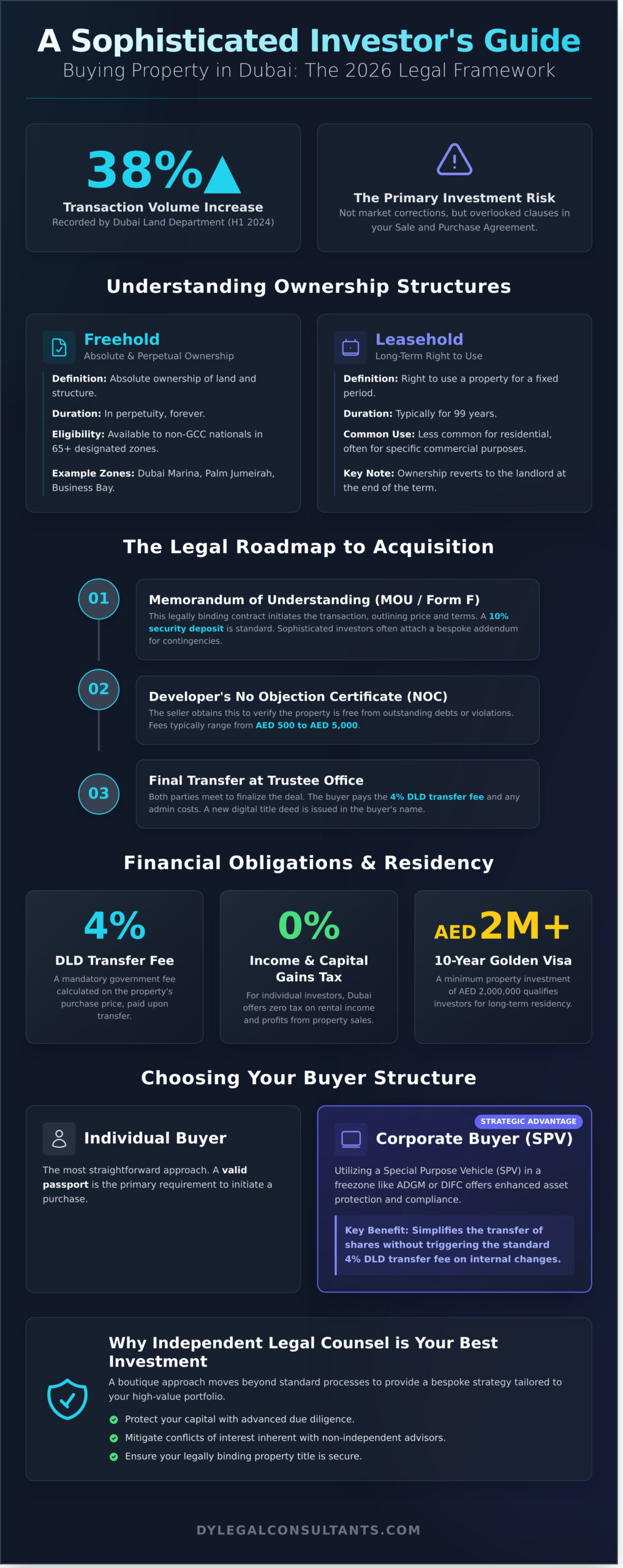
What if the primary risk to your capital isn’t a market correction, but a single overlooked clause in your Sale and Purchase Agreement? You’re right to be cautious when buying property in dubai, especially since the Dubai Land Department recorded a 38% increase in transaction volumes during the first half of 2024. While the growth is undeniable, the anxiety surrounding developer delays or the distinction between freehold and leasehold rights is a valid concern for any sophisticated investor. You deserve a secure, strategic entry into this market that prioritizes your legal protection over mere speed.
Our boutique approach ensures you move beyond the confusion of complex paperwork and unexpected administrative costs. We promise to provide a professional framework that secures your legally binding property title and clarifies the total cost of ownership in UAE Dirhams (AED). You’ll discover how to leverage your investment to qualify for the 10 year Golden Visa and protect your assets against project abandonment. This guide outlines the essential legal milestones and strategic checkpoints required to manage the 2026 regulatory framework with absolute confidence.
Key Takeaways
- Navigate the 2026 regulatory landscape by mastering the distinction between freehold and leasehold rights to secure your long-term ownership.
- Streamline your acquisition process by understanding the critical legal milestones, from drafting the Memorandum of Understanding (Form F) to securing the developer’s NOC.
- Protect your capital when buying property in dubai by implementing advanced due diligence protocols that verify title ownership and the seller’s legal capacity.
- Quantify your total investment accurately with a comprehensive breakdown of DLD registration fees and VAT obligations calculated in AED.
- Leverage the boutique advantage of independent legal counsel to mitigate conflicts of interest and ensure a bespoke strategy tailored to your high-value portfolio.
Understanding the Dubai Real Estate Framework in 2026
In 2026, the Dubai real estate sector operates within a highly sophisticated legal framework that prioritizes transparency and investor protection. The Dubai Land Department (DLD) serves as the primary registrar, ensuring every transaction is recorded with absolute precision. Its regulatory arm, the Real Estate Regulatory Agency (RERA), sets the operational standards that brokers and developers must follow. This dual-structure approach has solidified the city’s reputation as a secure destination for global capital. A strategic approach to buying property in dubai begins with recognizing these regulatory pillars as assets rather than hurdles.
Investors continue to view the emirate as a premier safe haven. This is supported by a UAE real estate market overview which highlights the transition from a regional hub to a global powerhouse. As of January 2026, transaction volumes have maintained a steady 12% year-on-year growth. The 10-year Golden Visa program, which requires a minimum investment of 2,000,000 AED, remains a primary driver for long-term residency. The tax environment remains exceptionally favorable; there’s a 0% tax on capital gains and rental income for individual investors, providing a level of fiscal clarity rarely found in other global markets.
Freehold vs. Leasehold: Navigating Ownership Boundaries
Ownership rights in the emirate are divided into two distinct categories. Freehold is the absolute ownership of land and structure in perpetuity. This right is granted to non-GCC nationals within over 65 designated zones, including iconic districts like Palm Jumeirah, Dubai Marina, and Business Bay. Leasehold rights, by contrast, offer the right to use a property for a fixed period, typically 99 years. While leasehold is less common for residential buyers, it serves specific commercial purposes in certain older districts. Understanding these boundaries is an essential first step for anyone buying property in dubai during this cycle.
Eligibility and Legal Structures for Buyers
Individual buyers only require a valid passport to initiate a purchase. However, corporate entities must meet more rigorous compliance standards. Many sophisticated investors now utilize a Special Purpose Vehicle (SPV) registered in the Abu Dhabi Global Market (ADGM) or the Dubai International Financial Centre (DIFC). This boutique legal structure provides enhanced asset protection and simplifies the transfer of shares without triggering the standard 4% DLD transfer fee on every internal change. It’s a proactive way to manage a portfolio while maintaining high standards of integrity.
For international corporations, the DLD requires a Certificate of Incumbency and a Board Resolution, which must be legalized by the UAE Ministry of Foreign Affairs. These requirements ensure that every entity holding land in the emirate is verified and compliant with global anti-money laundering (AML) standards. While these steps add a layer of complexity, they’re vital for maintaining the market’s long-term stability and protecting your investment from regulatory shifts. We focus on making this process seamless, ensuring your corporate structure aligns with local mandates from day one.
The Legal Roadmap: Step-by-Step Property Acquisition
The process of buying property in Dubai follows a methodical framework designed to protect all parties involved. It begins with the Memorandum of Understanding (MOU), officially known as Form F. This document is the foundation of the transaction. It’s a legally binding contract that outlines the purchase price, payment schedule, and closing date. While Form F is a standard template provided by the Dubai Land Department, sophisticated investors often attach a bespoke addendum. These additional clauses address specific contingencies, such as mortgage rejection or structural defects found during inspection. A standard 10% security deposit is typically held by a neutral third party, such as the buyer’s broker or a legal consultant, until the transfer is complete.
Once the MOU is signed, the seller must obtain a No Objection Certificate (NOC) from the developer. This step ensures the property is free from outstanding service charge debts or building violations. Fees for an NOC generally range from AED 500 to AED 5,000, depending on the developer’s specific policies. After the NOC is issued, the parties meet at a Trustee Office to finalize the transfer. During this meeting, the buyer pays the 4% transfer fee and any administrative costs to Dubai’s official property registration authority. The transaction concludes with the issuance of a digital title deed, after which the buyer can proceed with utility registrations through DEWA and the Empower cooling system.
Contractual Milestones: From MOU to SPA
For secondary market sales, Form F holds primary legal weight. However, for off-plan projects, the Sales and Purchase Agreement (SPA) is the dominant document. It’s vital to scrutinize clauses regarding force majeure and delay penalties. Recent 2024 market trends show an increase in detailed termination rights if a developer fails to meet specific construction milestones. Securing a bespoke legal review of these terms ensures your interests remain protected throughout the lifecycle of the investment.
The Role of Escrow Accounts in Off-Plan Purchases
Investor protection in the off-plan sector is anchored by Law No. 8 of 2007. This regulation mandates that developers cannot access buyer funds for personal use or other projects. 100% of investor funds must be deposited in a RERA-approved escrow account. These funds are only released to the developer in stages, verified by independent project consultants as construction hits specific percentages of completion. This system provides a strategic safety net for anyone buying property in dubai.
- Verification: Use the Dubai REST app to check the project’s registration number and current construction status.
- Escrow Status: Confirm the specific bank and account number associated with the project before making any transfers.
- Compliance: Ensure every payment receipt is issued through the official Oqood system, which serves as a pre-title registration for off-plan units.
The transition from a signed agreement to a registered title deed requires meticulous attention to detail. By following this established roadmap, buyers can navigate the UAE’s regulatory landscape with absolute clarity. The system is built for speed, but its integrity relies on the buyer’s commitment to following every statutory requirement without exception.
Legal Due Diligence: Mitigating Risks in High-Value Deals
Standard agency checks are often surface-level. They confirm the property exists but rarely probe the legal liabilities attached to the owner or the asset. Professional investors require a more bespoke approach to risk management. Before committing millions of AED to an acquisition, you must verify the seller’s legal capacity. For corporate sellers, this involves reviewing the Memorandum of Association and valid trade licenses. For individuals, a thorough check of the Power of Attorney (PoA) is vital. A PoA older than two years usually requires re-validation by Dubai Courts to ensure it remains active and legally binding. We’ve seen transactions stall because an outdated PoA was rejected at the final transfer stage.
Verifying Title Deeds and Encumbrances
A clean title is the foundation of a secure investment. You should perform a title search through the Dubai Land Department (DLD) to identify any registered mortgages, liens, or legal blocks. When buying property in dubai, understanding the status of existing tenants is equally crucial. Under Law No. 33 of 2008, a landlord must provide a 12-month written notice via Notary Public to evict a tenant for the purpose of selling. Failure to verify this can result in unexpected legal delays and lost rental yields. For off-plan assets, ensure the property has an “Oqood” registration. This interim title deed protects your rights before the project’s completion. Detailed UAE government regulations for foreign property owners provide the specific framework for these ownership rights and the necessary registration procedures.
Developer and Project Vetting
Project history is a reliable predictor of future performance. We analyze developer track records, focusing on their history of delivery delays or past litigation. Verify that the project has a registered Escrow account. This ensures your funds are only released as construction milestones, such as 20% or 50% completion, are met. It’s also vital to review the Jointly Owned Property (JOP) declarations. These documents outline the service charge structures and your rights regarding common areas. High service charges can erode your ROI by as much as 15% to 25% annually if they aren’t audited against market standards. For a structured approach to these risks, consult our Legal Due Diligence Checklist for UAE Businesses.
A physical inspection serves a critical legal function beyond simple aesthetics. Identifying structural defects before the final transfer allows you to demand rectification under the developer’s one-year defect liability period or the 10-year structural warranty. In the Dubai market, these warranties are statutory protections that safeguard your capital. If you don’t commission a professional snagging report, you may inadvertently waive your right to claim for latent defects that appear several months later. Strategic foresight during the inspection phase prevents costly litigation and ensures the asset is delivered exactly as promised in the Sales and Purchase Agreement (SPA). This proactive stance is what separates a standard purchase from a secure, high-value investment.
Financial Obligations and Residency Integration
Successful property acquisition requires more than just capital; it demands a forensic understanding of the UAE’s fiscal framework. When buying property in dubai, investors must look beyond the sticker price to account for mandatory government levies and administrative overheads. This strategic approach ensures that your investment remains a high-yielding asset rather than a source of unforeseen liabilities. Our boutique firm emphasizes clarity in these calculations to provide you with a seamless transition into the local market.
The Total Cost of Acquisition in Dubai
The Dubai Land Department (DLD) mandates a 4% transfer fee on the total property value. While Article 22 of Executive Council Resolution No. (30) of 2013 suggests this fee is shared between buyer and seller, market practice almost exclusively places the 100% burden on the buyer. You’ll also need to budget for the following fixed costs:
- Trustee Fees: Expect to pay AED 4,000 plus 5% VAT for properties valued above AED 500,000, or AED 2,000 plus VAT for those below this threshold.
- Administration Fees: A standard DLD fee of AED 580 applies to apartments and villas, while land plots incur AED 430.
- Registration Fees: Title deed issuance typically costs AED 250.
- Utility Deposits: DEWA (Dubai Electricity and Water Authority) requires a refundable deposit of AED 2,000 for apartments and AED 4,000 for villas.
Tax implications vary significantly based on the asset class. Residential properties are generally zero-rated or exempt from VAT, provided the transaction occurs within three years of the building’s completion. Conversely, commercial real estate attracts a mandatory 5% VAT. For expat investors utilizing leverage, the Central Bank of the UAE sets strict Loan-to-Value (LTV) ratios. First-time expat buyers can secure up to 80% financing for properties valued under AED 5,000,000, while subsequent purchases or higher-value assets see this cap drop to 60% or 65%.
Property Investment as a Path to UAE Residency
The 2026 Golden Visa framework continues to incentivize buying property in dubai by linking high-value acquisitions to long-term residency. This isn’t a mere byproduct of ownership; it’s a structured legal process that begins once the DLD issues the final title deed. To qualify for the prestigious 10-year Golden Visa, your total investment must meet a minimum threshold of AED 2,000,000. This can be a single property or a combined portfolio, provided the equity held in the assets meets the valuation requirement.
For those seeking shorter-term stability, a 2-year residency visa is available for investments of at least AED 750,000. The legal framework requires the property to be habitable and the investor to provide a clear police conduct certificate. You can find more details on these requirements in our comprehensive Dubai Real Estate Law: A Guide for Investors. Once the title deed is in hand, the application is processed through the Dubai Land Department’s “Cube” center, which provides an integrated service for medical fitness tests and Emirates ID biometrics. This streamlined system reflects the UAE’s commitment to a pro-business environment where legal compliance serves as a strategic asset for global citizens.
Secure your investment strategy and residency future with a bespoke legal consultation from our specialist team.
Why Independent Legal Counsel is Your Best Investment
Buying property in dubai represents a significant financial commitment that requires more than just a real estate agent’s signature. While brokers facilitate the connection between buyer and seller, their primary incentive remains the transaction’s closure to secure a standard 2% commission plus VAT. This creates an inherent conflict of interest. Independent legal counsel serves as your dedicated advocate, ensuring your interests remain the sole priority throughout the acquisition process. At DY Lawyers and Legal Consultants, we provide a boutique advantage that prioritizes strategic depth over the high-volume approach of larger agencies. We don’t just process paperwork; we build a protective framework for your capital.
Construction delays and breaches of contract are real risks in any fast-developing market. Under Law No. (13) of 2008, investors have specific protections regarding off-plan projects and the use of escrow accounts. If a developer fails to meet completion milestones, you need a firm that understands how to navigate Dubai Land Department (DLD) protocols effectively. Our team manages these disputes with a proactive mindset, aiming for resolution before costly litigation becomes necessary. This strategic foresight protects your initial 10% to 20% down payment from being tied up in stalled developments. We implement a rigorous 12-point due diligence checklist for every acquisition, verifying developer track records and ensuring the property is free of undisclosed encumbrances.
Bespoke Legal Support for International Investors
International investors face unique hurdles that require tailored solutions. We structure your purchase to align with global tax obligations and long-term estate planning goals. For remote buyers, our Power of Attorney (POA) services allow for seamless execution of the Memorandum of Understanding (MOU) without the need for travel. We ensure every document complies with UAE Federal Decree-Law No. (42) of 2022, preventing the administrative fines that often arise from non-compliant filings. Our approach is precise, methodical, and designed for those who value high-touch service.
Securing Your Future in the Dubai Landscape
Asset protection extends far beyond the initial transfer of the Title Deed. We integrate your real estate holdings into a broader legal strategy, often utilizing DIFC or ADGM Wills to ensure your legacy remains intact according to your specific wishes. This is a critical step for non-Muslim investors looking to bypass default inheritance distributions. Moving from a transactional mindset to a strategic partnership with DY Lawyers and Legal Consultants provides you with a reliable anchor in the UAE’s dynamic regulatory environment. We’re committed to your long-term success, providing the clarity and security needed to grow your portfolio with confidence.
Contact DY Lawyers and Legal Consultants for a Bespoke Property Consultation to ensure your investment in buying property in dubai is legally sound and strategically optimized.
Mastering the 2026 Dubai Investment Landscape
The 2026 market presents a sophisticated environment where regulatory compliance is the cornerstone of capital appreciation. Investors must prioritize the AED 2,000,000 threshold for residency integration while ensuring every Title Deed and Oqood registration undergoes rigorous verification. Buying property in dubai is no longer just about the location; it’s about the strategic framework you build around your assets to mitigate risk in a fast-moving economy.
DY Legal Consultants operates as your dedicated partner in this journey. We’re a boutique firm with deep local expertise, specializing specifically in Real Estate and Construction Law. Our solution-driven approach ensures that high-value deals are handled with the precision and integrity they require. We don’t just identify hurdles; we provide the bespoke legal architecture needed to clear them. You’ll find that having elite, specialized counsel transforms a complex transaction into a seamless transition for your portfolio.
Secure your Dubai investment with expert legal counsel
We look forward to helping you build a lasting legacy in the UAE with confidence and clarity.
Frequently Asked Questions
Can foreigners buy property anywhere in Dubai in 2026?
Foreigners can own property with 100% freehold status only within designated zones approved by the Ruler of Dubai. While non-residents can’t purchase in non-freehold areas like Jumeirah 1 or Al Rashidiya, the list of freehold zones has expanded to over 65 areas as of 2024. These include popular hubs like Dubai Marina, Downtown Dubai, and Palm Jumeirah. Navigating these boundaries ensures your investment remains compliant with Law No. 7 of 2006.
What are the mandatory fees when buying property in Dubai?
You’ll pay a 4% Dubai Land Department (DLD) fee based on the property value, plus an administrative fee of AED 580 for apartments or AED 430 for land. Most transactions also involve a 2% brokerage commission plus 5% VAT. Additionally, registration trustee fees range from AED 2,000 to AED 4,000 depending on the purchase price. Factoring these costs early creates a seamless financial framework for buying property in dubai.
How long does the property transfer process take in Dubai?
The standard property transfer process typically concludes within 14 to 30 days from the signing of the Memorandum of Understanding. This timeline depends on the speed of obtaining the No Objection Certificate from the developer, which usually takes 5 to 7 working days. Once the DLD appointment is set, the final transfer of ownership often happens in a single session lasting less than 90 minutes. It’s a highly efficient system designed for global investors.
Is a lawyer required for buying property in Dubai?
While UAE law doesn’t strictly mandate hiring a lawyer, engaging a boutique legal consultant is a strategic asset for mitigating risk. We review the Sales and Purchase Agreement and verify the seller’s title to prevent future disputes. For international investors, having a legal representative manage the escrow and contract nuances ensures the transaction aligns with the latest 2026 regulatory standards. It’s about securing your capital through professional due diligence.
What happens if a developer delays the completion of my off-plan property?
Investors are protected by Executive Council Resolution No. 6 of 2010 if a developer fails to deliver. Most contracts allow a 12 month grace period for completion. If delays exceed this without a valid force majeure, you’re entitled to seek a refund or compensation through the Dubai Land Department. We provide bespoke strategies to help clients navigate these disputes and recover their funds through the proper legal channels, ensuring your rights aren’t compromised.
Can I get a Golden Visa by buying a property in Dubai?
You can qualify for a 10 year Golden Visa by buying property in dubai with a minimum value of AED 2,000,000. This threshold applies to the total equity held in the property, even if it’s mortgaged or off-plan, provided the paid-up amount meets the requirement. This residency status offers long-term stability for your family and domestic staff. It’s a powerful tool for those looking to establish a permanent base in the UAE’s thriving economy.
What is the difference between Oqood and a Title Deed?
Oqood is an interim registration certificate issued by the DLD to secure your rights during the construction of an off-plan property. Once the project reaches 100% completion and is handed over, the Oqood is replaced by a formal Title Deed. Both documents are legally binding and registered in the DLD’s central system. This dual-stage framework ensures that your ownership interest is protected from the moment you sign the initial contract until you receive the keys.
How do I verify if a real estate broker is legal in Dubai?
You must verify a broker’s credentials by checking their RERA Broker ID through the Dubai REST mobile application. Every legal agent must hold a valid permit and be linked to a licensed brokerage firm. Dealing with unregistered individuals is illegal and leaves you without protection in the event of fraud. A quick search on the DLD portal provides instant transparency, confirming the professional’s status and history within the Dubai market landscape.
